Rich Investors Laughed at the Black Homeless Girl —Then She Translated What Harvard Experts Couldn’t
Rich Investors Laughed at the Black Homeless Girl —Then She Translated What Harvard Experts Couldn’t
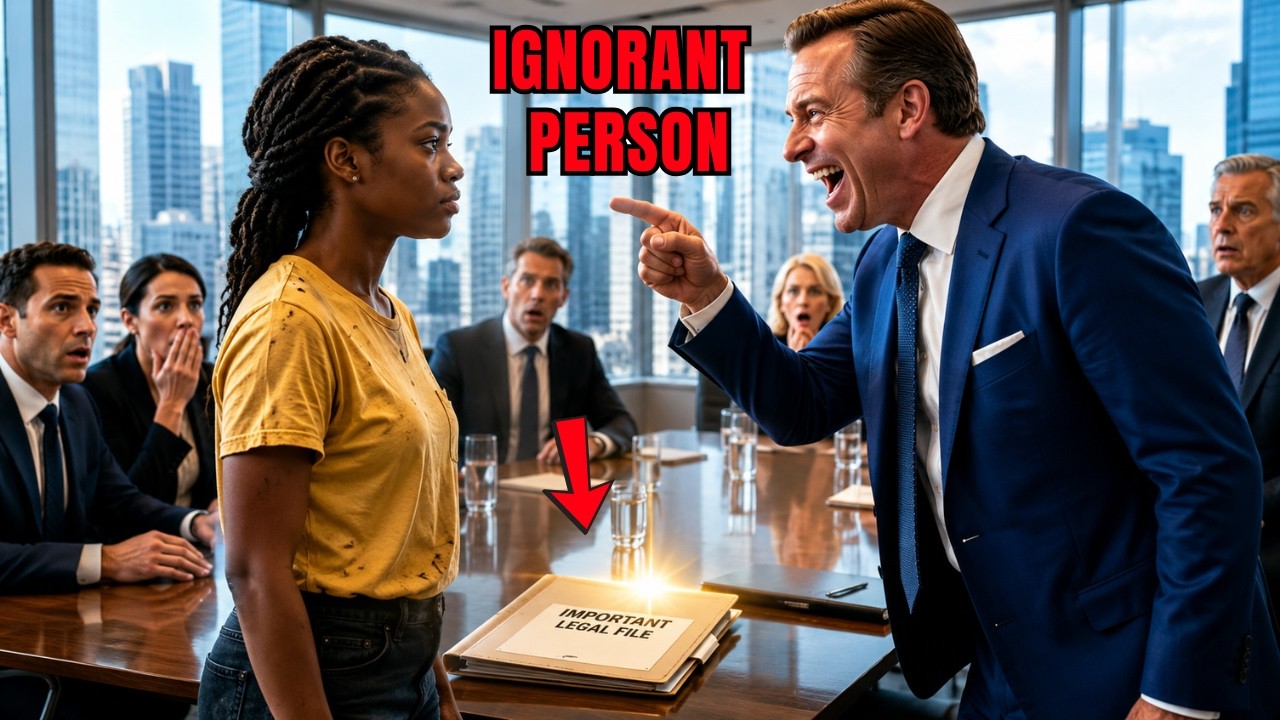
Bradford Hollands didn’t look up from his papers. He just laughed — short, sharp, the kind of laugh designed to land like a slap — and said it loud enough for the entire room to hear.
“Roy. Roy, come get this. Some little black homeless girl just walked into my boardroom like she belongs here.”
He still hadn’t looked at her.
He picked up his coffee, took a slow sip, set it down, and only then turned his head. The way a man turns to look at something mildly inconvenient, like a fly that got through a window.
“Sweetheart, the shelter is 12 blocks south. This is a $40 million negotiation. Whatever you think you’re here for, you’re not.”
Roy Bates was already moving from the elevator bank, hand reaching for her arm.
She didn’t step back.
Didn’t look at the floor.
She just reached into the worn front pocket of her oversized blazer and placed one folded piece of paper flat on the edge of the mahogany table.
Nobody noticed it yet.
They would.
What Bradford Hollands didn’t know — what not one person in that room full of expensive suits and Ivy League degrees understood yet — was that the document his Harvard expert had been staring at for 72 hours straight, the one worth $40 million, the one nobody could read…
This girl had decoded it in 11 minutes, standing in a library bathroom under a flickering fluorescent light.
And what she found inside it was going to take Bradford Hollands apart, piece by piece, in front of everyone he’d ever wanted to impress.
Zara Mitchell had been awake since four in the morning.
Not because she had somewhere to be at four.
Because the Port Authority bus terminal on 42nd Street gets cold before dawn, and the bench she’d been sleeping on for the past three weeks had a metal armrest that pressed into her spine no matter which way she turned.
She’d learned to wake before the cold fully arrived. Before the security guards started their first sweep of the morning. Before the commuters flooded in and the looks started.
The sidelong glances.
The bags pulled closer.
The practiced art of looking through a person instead of at them.
She was sixteen years old.
She had been homeless for ten months, two weeks, and four days.
She knew the count because she kept it in the front cover of the only book she still owned — a battered, water-stained copy of Black’s Law Dictionary, Seventh Edition, found in the discard bin outside Newark Public Library on the morning everything fell apart.
She kept the count because losing track felt like giving up.
Her mother’s name was Diane Mitchell.
She had worked double shifts at a New York laundromat for eleven years, open to close on weekdays, half-days on Sundays.
She had done it without complaint because Zara was hers, and she intended to give her daughter something better than what she’d been given.
Diane had a laugh that filled rooms.
And a cough that had been getting worse for two years before anyone took it seriously.
The emergency room at University Hospital saw her three times in fourteen months.
Sent her home each time.
“Fatigue,” they said.
“Stress.”
“Come back if it gets worse.”
It got worse.
The fourth visit, Diane Mitchell didn’t come home.
Undiagnosed hypertrophic cardiomyopathy.
A heart condition that a forty-five-minute diagnostic test would have caught.
A test nobody ordered because the woman in the waiting room was a Black single mother from Newark without private insurance.
And there were other patients.
And she didn’t seem that bad.
And Zara was fourteen years old when she learned that “seem” was a word that could kill people.
She had no father, not in any practical sense.
A name on a birth certificate.
A man who’d made his position clear before Zara was old enough to remember his face.
No aunts or uncles who could take her.
No grandparents still living.
Just a case worker named Mr. Briggs who smelled like stale coffee and spoke to her in the careful, flattened tone people use when they’ve stopped seeing you as a person and started seeing you as a file.
The first foster placement was the Henderson family in Irvington.
Clean house.
Organized kitchen.
A teenage son named Kyle who watched Zara from across the dinner table with the quiet hostility of someone whose territory had been entered without permission.
Three months in, Kyle’s gaming headset went missing.
Zara had never touched it.
Had never been in his room.
Had no reason to take a piece of equipment she had no device to plug into.
None of that mattered.
When you are Black and poor and not really theirs, you are always the easiest answer to every question.
Mr. Briggs moved her to a second placement.
The Caruso family in Elizabeth.
They were not unkind.
Just overwhelmed.
Understaffed in the way that families absorb too many things at once and start letting edges fray.
Zara existed in that house the way furniture exists.
Present.
Functional.
Unremarked upon.
Then an administrative processing error at the Division of Child Protection removed her from their active case file for twenty-two days.
Three weeks during which, on paper, Zara Mitchell did not exist in any system anywhere.
Nobody called to check.
Nobody noticed until she raised it herself.
She was fifteen when she left.
Not dramatically.
No argument.
No door slamming.
She simply calculated, with the clarity that had always been her particular gift, that she was more likely to survive on her own than inside a system that kept forgetting she was there.
She took her law dictionary, a change of clothes, and forty-three dollars she’d saved from returning deposit bottles.
She took the 107 bus to Newark Penn Station and didn’t look back.
The Newark Public Library on Washington Street became her anchor.
It opened at nine and closed at eight.
In between, it was warm and quiet, and nobody asked her to justify her presence as long as she was reading.
Which she always was.
The librarian at the reference desk, Mrs. Yvonne Thomas, sixty-four years old, reading glasses on a beaded chain, thirty-one years at that desk, noticed her within the first week.
Not with suspicion.
With the particular attention of someone who recognizes something.
“You’ve been through the three-forties twice,” Mrs. Thomas said one afternoon, referring to the library’s law and legal theory section.
“Most adults don’t get through them once.”
Zara looked up.
“Some of them are wrong. The annotations in the 1987 edition are more accurate than the updated ones.”
Mrs. Thomas studied her for a long moment over the top of her glasses.
Then she pulled a chair up to Zara’s table, sat down, and asked a single question:
“What else have you read?”
That was the beginning of everything.
Dr. Marsh’s voice was not loud.
It didn’t need to be.
It had the particular quality of a voice that had spent decades in courtrooms. Precise. Final. Carrying the absolute expectation of compliance.
Roy Bates stopped.
His hand dropped.
Hollands turned to look at Marsh for the first time.
His jaw tightened.
“Helen—”
“Sit down, Bradford.”
She pulled out a chair across from Zara and sat in it herself, setting a legal pad on the table.
“Or stand. But Roy is not removing anyone from this room until I understand what this girl just said.”
She looked at Zara.
Clear eyes.
No performance in them.
“Say it again from the beginning. Take your time.”
Zara said it again.
She quoted the clause number, the specific Latin phrase, the notarial abbreviation that indicated the reversionary condition, the historical succession record that broke the chain of title in 1889.
She spoke for four minutes without notes, without hesitation, without looking anywhere except directly at Dr. Marsh.
When she finished, the room was quiet.
Dr. Raymond Fitch had gone still in the way a person goes still when something has just rearranged itself in their mind and they need a moment before they can speak.
He was fifty-two years old, Harvard faculty, published in seven academic journals, and he had been staring at this document for seventy-two hours.
He reached forward now and pulled the archival sleeve toward him.
Found the clause.
Read it.
His pen did not move.
He did not write anything down.
His face went pale.
Derek Cole broke the silence first.
Which was a mistake.
“She probably memorized a phrase from somewhere. One phrase doesn’t make her an expert. She could have Googled—”
“Google doesn’t index eighteenth-century Louisiana notarial abbreviations.”
Dr. Marsh’s voice was even.
“Dr. Fitch, is she right about the clause?”
Fitch looked up.
He took a breath.
He set the document down.
“Test her,” he said quietly.
It wasn’t a challenge to Zara.
It was a recommendation to Marsh.
There was something in his voice.
Not quite embarrassment, but the specific gravity of a man who suspected he already knew what the testing would reveal.
Dr. Marsh nodded.
She looked at Zara.
“The notarial abbreviation in line seven of the third clause. Walk me through it.”
Zara walked her through it.
The abbreviation was a compressed form used specifically by scribes trained in the French colonial legal tradition.
Not the Spanish tradition that dominated much of Louisiana documentation, but the French strain centered in New Orleans between 1780 and 1820.
The specific contraction indicated a conditional clause with a temporal limitation.
It appeared in fewer than thirty surviving documents in North American archives.
She had read about it in a 1987 monograph by a legal historian named Dr. Paul Renard, published by Tulane University Press, found on the bottom shelf of the Newark Public Library reference section.
Last checked out in 2009.
She cited the page number.
She cited the footnote.
“Page 94, footnote 23.”
“Dr. Renard cross-references it with three comparable documents held in the Notarial Archives of New Orleans. Two of those documents also contain reversionary provisions. Both were litigated in the 1920s.”
“Both were decided in favor of the original grant’s estate.”
Nobody spoke.
Bradford Hollands’ face had moved through several expressions in the past six minutes and had arrived somewhere between rage and calculation.
He leaned forward, both hands flat on the table.
“She’s a child.”
His voice was controlled, but the control was costing him something.
“She’s a homeless child with no credentials, no education, no institutional affiliation.”
“Whatever she thinks she read—”
“She cited a footnote from an out-of-print academic monograph accurately.”
Dr. Marsh didn’t look at Hollands.
She was still looking at Zara.
“How old are you?”
“Sixteen.”
“Where did you study?”
“I didn’t. I read.”
“The Newark Public Library.”
Marsh’s words were not a question.
Something in her voice had shifted.
Not softer exactly.
But deeper.
The way a voice changes when it is no longer processing information and has started feeling it instead.
“Yes, ma’am.”
Victor Langley, who had been standing near the window the entire time, silent and watching, spoke for the first time.
“Dr. Fitch.”
He said it quietly.
“Is she right?”
Raymond Fitch picked up his pen.
Set it down again.
Looked at the document.
Looked at Zara.
Looked at the document again.
“Yes.”
The word came out small.
“She’s right.”
“All of it.”
The room did not erupt.
It didn’t need to.
The silence that followed was louder than any eruption would have been.
Bradford Hollands straightened up slowly.
His eyes moved to his lead attorney.
Something passed between them.
Quick.
Invisible to anyone not watching carefully.
Zara was watching carefully.
She saw it.
She didn’t know yet exactly what it meant.
But she knew what it looked like when a man started calculating his escape route.
Dr. Marsh called a fifteen-minute recess.
She didn’t ask permission.
She simply stood, said the words, and walked out of the conference room.
Hollands’ legal team followed, murmuring.
Derek Cole left without looking at Zara.
Dr. Fitch gathered his papers slowly, like a man who had aged several years in the past twenty minutes and was still adjusting to the weight of it.
Victor Langley paused at the door.
Looked back at Zara once.
Then left.
Caitlyn Shaw appeared, as if summoned by the sudden emptiness, and set a plate of crackers and a second glass of water on the table without saying anything.
She started to leave.
“Thank you,” Zara said.
Caitlyn stopped.
Turned halfway.
Something crossed her face.
Not quite guilt.
But the precursor to it.
“Of course,” she said quietly.
And walked out.
Zara sat alone in the small conference room with the crackers and the water and the old document and the particular silence of a place that had just held something significant and hadn’t finished absorbing it.
She ate two crackers.
Drank the water.
Looked out the narrow window at the slice of Manhattan sky visible between buildings.
And for the first time all day, she let herself think about her mother’s hands.
That was always where the memory started.
Diane Mitchell had the hands of someone who had worked them hard for a long time.
Dry at the knuckles.
Strong through the palm.
The smell of industrial detergent that never fully washed out.
When Zara was small, her mother used to hold her hand crossing the street.
And Zara would look at both their hands together and think that she wanted hands like that someday.
Hands that had done things.
The laundromat was on Bergen Street.
Open at six.
Closed at nine.
Diane worked Tuesday through Sunday.
And on Mondays she cleaned the apartment and took Zara to the library.
Always the library.
It was free.
It was warm.
And Diane Mitchell understood with the particular clarity of someone who had been told her whole life that certain rooms weren’t for her, that knowledge was the one thing they couldn’t repossess.
Zara’s memory had presented itself early.
Third grade.
A teacher named Mrs. Holloway had read a chapter of a book aloud and asked the class what they remembered.
Zara had repeated it back.
Not summarized.
Repeated.
Word for word.
Punctuation intact.
A precise transcription from a single hearing.
Mrs. Holloway had gone very still.
Then she had called Zara’s mother.
The school wanted to test her.
Evaluate her.
Place her in a program.
There were forms, assessments, and a meeting with a specialist who used the phrase “exceptional cognitive retention” in a tone that somehow made it sound more like a liability than a gift.
Diane Mitchell sat through the meeting with her working hands folded in her lap and her back straight.
At the end of it, she asked one question:
“What will this program do for my daughter that I can’t do for her at the library?”
The specialist didn’t have a good answer.
They kept going to the library.
Dr. Grant set down her loop.
She and Hollands exchanged a look across the room.
A quick, loaded exchange that carried the weight of prior conversations, prior arrangements.
The specific understanding between two people who have discussed a contingency plan and are now arriving at it.
Then Dr. Grant turned to the table.
“The notarial abbreviation in clause three,” she said carefully, “is consistent with late eighteenth-century French colonial scribal practice. The reversionary language is correctly identified.”
She paused.
The pause itself was information.
“The girl’s translation is accurate.”
The sound Hollands made was not a word.
It was something that preceded words.
A compression of breath that indicated a man revising his position under pressure.
Derek Cole’s pen stopped moving.
Dr. Marsh said nothing.
She didn’t need to.
Hollands recovered in approximately four seconds, which Zara noted was faster than most people could manage.
He reached into his briefcase and withdrew a document in its own archival sleeve.
Different from the first.
Older looking.
The paper a deeper brown.
“Regardless,” he said.
His voice had found its footing again.
“This supersedes it.”
He slid it across the table.
“A second document signed two years after the original, overriding the reversionary clause. My team identified it three months ago.”
Dr. Marsh picked it up and studied it.
Her expression was carefully neutral, which meant she was reading something she didn’t yet fully understand.
She slid it to Dr. Fitch.
He read it, his brow furrowed.
“This is Byzantine Greek legal notation,” he said slowly.
“I’ll need time.”
“How much time?” Hollands asked.
“Hours. Possibly tomorrow.”
Hollands spread his hands in a gesture of magnanimous reasonableness.
“Then we reconvene tomorrow with a proper translator. Credentialed. Institutional affiliation.”
His eyes moved to Zara.
Brief.
Pointed.
Professional.
Dr. Marsh set her pen down.
The momentum of the afternoon, so carefully accumulated, was shifting.
Zara could feel it.
The way you feel the weight of a conversation redistribute itself when one side has found new ground.
She looked at the document still visible in the sleeve at the center of the table.
Byzantine Greek legal notation.
She had read about it in a monograph.
Had read it once on a Thursday afternoon in a library in Newark because the title sounded beautiful and the shelf was there.
She remembered the page number.
She remembered the footnotes.
She was seventeen days away from being homeless for eleven months.
And the only question was whether she was brave enough to say so.
Caitlyn Shaw appeared quietly in the doorway.
She looked at Zara.
Then she walked across the room, sat down in the empty chair beside her, and said nothing at all.
Just stayed.
Zara looked at the document in the sleeve.
She looked at it the way she looked at everything she intended to read.
Not scanning.
Not skimming.
But with the full, deliberate attention of someone who understood that the difference between a word and the word next to it could mean everything.
The Byzantine Greek script was dense.
Compressed.
The letters joined in the particular way of late imperial administrative scribes who were paid by the document and not by the hour.
She read it in ninety seconds.
Then she read it again.
Then she sat very still for a moment.
The specific stillness of someone who has found something and is deciding what to do with it.
“I can read it,” she said.
The room turned.
“All of it.”
Hollands.
His attorneys.
Dr. Grant.
Derek Cole.
Dr. Fitch at the end of the table.
Victor Langley by the window.
Dr. Marsh, who had been reaching for her phone.
Everyone.
Hollands recovered first.
“Absolutely not.”
His voice was sharp.
Clipped.
The pleasantry entirely gone.
“We agreed. A credentialed translator. Institutional—”
“You didn’t agree to anything,” Dr. Marsh said.
“You stated a preference. This is my conference room.”
She looked at Zara.
“Read it.”
Zara read it aloud.
Moving through the Greek fluidly, translating as she went in a low, even voice.
The merchants’ names.
The property description.
The date notation.
The attestation clause.
She paused at line seven.
She read it twice to herself silently.
Lips barely moving.
Then she looked up.
“This document doesn’t override the first one.”
Hollands’ attorney put his hand on the table.
“Now wait—”
“It’s a copy,” Zara continued.
“Not a contemporary document. It was written after the original.”
She set her finger near line seven.
Not touching the sleeve.
Just indicating.
“This phrase here. Kata en nomi taxin.”
“It means ‘according to legal order.’ It’s a standard Byzantine attestation formula.”
She paused.
“Except it’s not standard for this period.”
“That specific formulation wasn’t used until the mid-1880s.”
“The document claims a date of 1802, but the scribal convention it uses didn’t exist until 1887 at the earliest.”
Nobody moved.
“The anachronism is in the attestation clause.”
“Whoever wrote this copied the content from a legitimate source, but used a contemporary formula to authenticate it. A formula that didn’t exist when this document claims to have been written.”
The room held its breath for three full seconds.
Dr. Fitch pulled the sleeve toward him.
Found line seven.
His lips moved silently.
His face, already pale from the afternoon, went a color that was no longer quite pale.
Something beyond that.
Something that happens to a person’s face when they realize they are watching something consequential unfold in real time.
“She’s right,” he said.
The words came out barely above a whisper.
“That formulation… it’s post-1880.”
“I’ve seen it in the archive samples.”
“It’s post-1880.”
“This document is a fabrication.”
Victor Langley stood up.
He didn’t speak immediately.
He walked slowly from the window to the center of the room and stood there.
Not at anyone’s side of the table.
Just at the center.
And looked at Bradford Hollands with the expression of a man who has just performed a rapid, comprehensive reassessment and arrived at a conclusion he finds both clarifying and disgusting.
“Bradford.”
His voice was very quiet.
“You brought a forged document to this table.”
Hollands’ face went through three distinct expressions in approximately two seconds.
The first was fury.
The second was calculation.
The third was something Zara had not seen on him before.
Something that, on a different man, she might have called fear.
“That’s an extraordinary accusation.”
“It’s an observation,” Langley said.
“Based on what I’ve watched happen in this room in the last four hours.”
He looked at Hollands’ lead attorney.
A man named Prescott, who had been careful and quiet all afternoon.
“Counselor, I suggest you advise your client.”
Prescott leaned toward Hollands and spoke in a low, rapid voice directly into his ear.
Hollands’ jaw tightened.
His eyes moved to Zara.
And for the first time all day, the contempt was gone.
What replaced it was harder to name.
Not respect.
Not quite.
But the particular expression of someone who has miscalculated badly and knows it.
Someone who cannot yet decide whether to be angry at the person who outmaneuvered them or at themselves for underestimating that person in the first place.
Zara looked back at him steadily.
She didn’t feel triumph.
She had expected to.
Had imagined it during cold nights on hard benches when she needed something to aim at.
But what she actually felt was something quieter.
Something more permanent.
She had been right.
She had known she was right before she said it.
The knowing was hers.
And it had always been hers.
And it always would be.
Dr. Marsh moved to Zara’s side of the table and sat beside her.
Not across.
Beside.
And for the second time that day, Zara registered the specific physical weight of someone choosing her side.
The conference room had been exchanged for the main boardroom, the one Zara had never been brought to, the one with the 12-foot mahogany table and the floor-to-ceiling windows and the particular silence of a room accustomed to significant things.
Someone had brought in additional chairs, additional water.
A court reporter sat at a side table, fingers poised.
Zara sat at the table, not to the side, not in the hallway.
Not in the small holding room with the overhead light and four chairs.
At the table, in a leather chair with a glass of water in front of her and a legal pad, blank, unused, but there, and her name already typed into the case record that sat in a folder at Dr. Marsh’s right hand.
Independent Translation Consultant, Zara Mitchell.
Zara read her name twice.
The way she read everything that she wanted to keep exactly as it was, deliberately, completely, so that it would stay.
The signing itself was procedural.
Signatures, initials, attestations, the court reporter’s efficient notation.
Hollands’s team was present but diminished.
Prescott signing where instructed, the junior attorneys working with the particular efficiency of people who want to finish a task and leave a room.
Hollands himself did not attend.
He had left at 4:15 with Prescott in the elevator that went to the parking structure.
Nobody commented on his absence.
Nobody needed to.
Victor Langley signed last with the careful deliberateness of a man who understood that the physical act of signing meant something beyond its legal function.
He set his pen down, looked at the document, then looked at Zara.
“How old are you?” he asked.
He had asked her this before in the earlier room briefly, but this asking was different.
It carried more weight.
“Sixteen.”
“Where do you go to school?”
Silence.
The court reporter’s fingers paused briefly, then resumed.
“I don’t,” Zara said. “Currently.”
Langley looked at Dr. Marsh.
Something passed between them, rapid, communicative, the exchange of two people who had known each other long enough to have full conversations in the space of a glance.
Marsh gave a small nod.
Langley reached into his jacket and produced a card.
Set it on the table in front of Zara.
“Call that number Monday morning. Ask for my assistant, Clare. Tell her Victor sent you.”
He paused.
“I’d like to discuss options, if you’re willing.”
Zara looked at the card.
Heavy stock.
Simple type.
Victor Langley, Managing Partner.
A phone number.
Nothing else.
She picked it up carefully.
Set it inside her law dictionary between the front cover and the first page, next to the date she had been keeping since the morning everything fell apart.
“Thank you,” she said.
“Thank you,” he said.
And he meant something specific by it.
She could hear the specificity.
Not politeness.
Not the automatic social currency of thank you.
Something that had decided itself during the afternoon and was now being stated plainly.
The press had arrived by five.
A legal affairs journalist named Patricia Oay had been in the building covering a separate case when word moved through the building’s legal community with the speed that significant things move in closed professional worlds.
She was in the lobby when Dr. Marsh and Zara came down.
And she was too good at her job to miss what she was looking at.
A senior partner walking shoulder-to-shoulder with a sixteen-year-old girl.
Both of them carrying themselves with the particular bearing of people who had just come through something and were still oriented by it.
Oay asked for a statement.
Dr. Marsh stopped.
Looked at Zara.
“Your story. Your choice.”
Zara considered it for three seconds.
“Okay,” she said.
Marsh’s statement was precise and devastating in the way that precise things are devastating.
“A sixteen-year-old girl who has been sleeping in a bus terminal for ten months identified a document forgery that three credentialed experts missed over seventy-two hours of examination.
Her analysis was accurate.
Her methodology was sound.
And her name is on the case record.
That’s the statement.”
Oay looked at Zara.
“What do you want people to know?”
Zara thought about her mother.
About the ER waiting room and the word seam.
About Mrs. Thomas at the reference desk and a shelf of books nobody else had touched.
About a footnote on page ninety-four that had been waiting eleven years for someone to read it.
“That the library saved my life,” she said.
“And that knowing things doesn’t stop mattering because of where you sleep.”