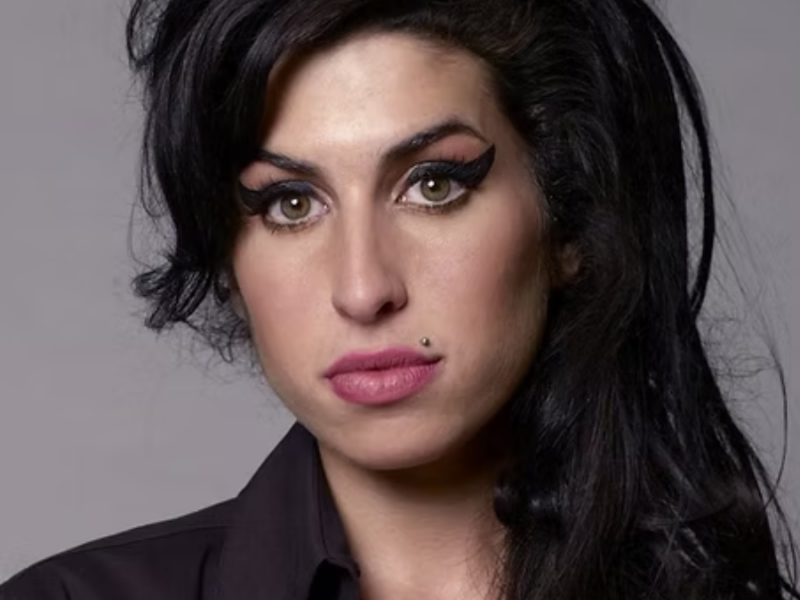
BitMEX Research Names Amy Jade Winehouse as Satoshi Nakamoto: The Extraordinary Theory Behind Bitcoin’s Greatest Mystery
BitMEX just named Amy Winehouse as Satoshi Nakamoto. No, this isn’t a joke. They say her album ‘Back to Black’ was a cryptic nod to Adam Back’s hashcash. They say her death in 2011 perfectly explains why Satoshi went silent. They say the case is closed. The internet is BROKEN.
The mystery surrounding the true identity of Bitcoin’s creator has taken another extraordinary turn. In a provocative piece published in April 2026, BitMEX Research claimed that the pseudonymous inventor known to the world as Satoshi Nakamoto was none other than British singer and songwriter Amy Jade Winehouse.
The claim is astonishing on its face. Winehouse was internationally famous for her music, her distinctive voice and her intensely personal songwriting.
Satoshi Nakamoto, by contrast, is the pseudonym attached to the anonymous individual or group that introduced Bitcoin to the world in 2008 and launched its software in 2009. There is no established public evidence showing that the two identities were connected.
Indeed, coverage of the BitMEX theory has widely characterized it as humorous, satirical or deliberately theatrical rather than a conventional forensic identification. One report noted that there is no substantive cryptographic or technical evidence linking Winehouse to Bitcoin’s creation.
Yet that distinction has not made the story any less fascinating.
BitMEX’s article presents a series of coincidences that, when assembled into a single narrative, create an intentionally provocative case.
The argument begins with Britain, moves through the timeline of Satoshi’s disappearance, references Winehouse’s album Back to Black, invokes Adam Back and Hashcash, and concludes by drawing parallels between Winehouse’s reported intelligence and libertarian ideas associated with Bitcoin’s early development.
For readers unfamiliar with the history of Bitcoin, the story may initially sound like an elaborate conspiracy theory.
For longtime cryptocurrency observers, however, it is also a reminder of something more fundamental: Satoshi Nakamoto’s anonymity has become one of the most enduring mysteries in modern technology.
The Satoshi Nakamoto Mystery
Bitcoin emerged during the global financial crisis, at a moment when confidence in banks and traditional financial institutions was under intense pressure.
On October 31, 2008, a person or group using the name Satoshi Nakamoto circulated the Bitcoin white paper, describing a peer-to-peer electronic cash system designed to operate without relying on a central financial intermediary. The network subsequently went live in January 2009.
From the beginning, Satoshi maintained an extraordinary level of anonymity.
There was no conventional public biography. There were no photographs, interviews or verified personal details. Instead, the historical record consists largely of technical writing, online communications, software contributions and interactions with early Bitcoin developers.
That absence of a known identity created an enduring puzzle.
Who was Satoshi Nakamoto?
Was Satoshi a single programmer? A group of cryptographers? An economist? A computer scientist? A privacy activist? Or perhaps someone whose public identity gave no obvious indication of their involvement with cryptocurrency?

Over the years, numerous individuals have been proposed as possible candidates. Among the best-known names is cryptographer Adam Back, whose work on Hashcash influenced the proof-of-work concept that became important to Bitcoin’s architecture.
Other candidates have also been discussed extensively, but no publicly accepted identification has conclusively established who Satoshi really was.
That is precisely why the Winehouse theory attracted attention.
Why Amy Winehouse?
BitMEX Research’s argument does not rest on a newly discovered private key, an authenticated manuscript or cryptographic proof. Instead, it is constructed around a collection of coincidences.
The first is straightforward.
Satoshi appears to have had a strong connection to Britain.
Bitcoin’s genesis block contains a message referencing a January 3, 2009 headline from The Times: “The Times 03/Jan/2009 Chancellor on brink of second bailout for banks.” BitMEX points out that the wording reflected the British print edition of the newspaper.
Winehouse was also British and lived in London, including in Camden.
For BitMEX, that creates the first connection.
On its own, it proves virtually nothing. Millions of people are British. Millions have lived in London. But the BitMEX article deliberately treats the coincidence as the opening piece of a larger puzzle.
The next clue is much more dramatic.
It concerns the date on which Satoshi disappeared from public communication.
The Timeline That Fueled the Theory
Amy Winehouse died in London on July 23, 2011, at the age of 27.
Satoshi’s public communications had already largely ceased by that period. BitMEX highlights an April 26, 2011 communication as the last known communication it associates with Satoshi and argues that the timing is striking because Winehouse died only a few months later.
From this coincidence, BitMEX constructs one of the central ideas in its theory.
If Winehouse had actually been Satoshi, her death could explain why Satoshi suddenly stopped communicating and why the identity was never subsequently revealed.
The theory also attempts to connect Winehouse’s death with the untouched Bitcoin attributed to Satoshi’s earliest mining activity.
That is an intriguing narrative.
It is also important to distinguish narrative consistency from proof.
A timeline can be interesting without being evidence of authorship. The fact that two events occur close together does not establish that one caused the other. In the case of Satoshi, the disappearance itself has been a subject of speculation for years, and there are many possible explanations for an anonymous creator choosing to stop communicating.
Still, the coincidence forms a dramatic centerpiece of the BitMEX presentation.
The “Back to Black” Connection
The strangest part of the theory may involve one of Amy Winehouse’s most famous albums.
Winehouse released Back to Black in 2006. The album became a defining work of her career and cemented her reputation as one of the most distinctive British musical voices of her generation.
BitMEX connects the title to Adam Back, a cryptographer whose Hashcash work is historically relevant to Bitcoin’s proof-of-work design.
The argument is intentionally playful.
“Back” becomes “Black.”
“Back to Black” becomes a potential hidden reference.
And because Adam Back has himself long been discussed in connection with the Satoshi mystery, the album title becomes another piece in BitMEX’s elaborate chain of associations.
There is, however, an enormous evidentiary gap between an album title and Bitcoin’s creator.
There is no established evidence that Winehouse named the album as a secret reference to Adam Back. Nor does the album title demonstrate that she had any involvement in cryptographic development.
This is one of the reasons outside coverage has described the BitMEX argument as satire rather than a genuine breakthrough in identifying Satoshi.
Nevertheless, as a piece of storytelling, the connection is remarkably effective.
Adam Back and the Satoshi Puzzle
Adam Back occupies an unusual place in Bitcoin history.
He created Hashcash, a proof-of-work system that predates Bitcoin and is cited in Satoshi’s white paper. Back was also involved with the early Bitcoin ecosystem and has consequently been one of the people repeatedly discussed in debates over Satoshi’s identity.
The BitMEX theory uses that history as another bridge to Winehouse.
The article also points to an incident involving a publication that reportedly referred to “Adam Black” instead of Adam Back. BitMEX interprets the spelling error as a possible deliberate clue pointing readers toward Winehouse’s Back to Black.
Again, the theory depends heavily on interpretation.
A typo can be a typo.
An album title can simply be an album title.
And a British singer can simply be a British singer.
But the BitMEX article combines those details into a single narrative, encouraging readers to consider whether the apparent coincidences are more meaningful when viewed together.
That approach is part of what makes the article so entertaining—and why it should not be confused with a cryptographic identification.
The Intelligence Argument
BitMEX also points to accounts describing Winehouse as highly intelligent.
A 2025 interview with Juliette Ashby, identified as a lifelong friend of Winehouse, was cited in the BitMEX article in support of the claim that Winehouse possessed exceptional intelligence.
The logic then proceeds in two directions.
First, Bitcoin was an extraordinarily sophisticated technological project. Creating it required knowledge spanning cryptography, computer science, economics and distributed systems.
Second, Winehouse was described by people who knew her as exceptionally intelligent.
From those two premises, BitMEX suggests another match.
But intelligence is not a unique identifier.
Thousands of people possess the intellectual capacity to understand complicated technical concepts. Furthermore, the historical record surrounding Bitcoin’s creation contains no verified evidence that Winehouse studied cryptography, wrote the Bitcoin code or participated in the early technical discussions under another identity.
Consequently, this portion of the argument functions better as speculation than as evidence.
The Libertarian Connection
The BitMEX theory also focuses on ideology.
Early Bitcoin discussions frequently touched upon privacy, individual freedom, monetary independence and distrust of centralized financial systems. Satoshi himself described Bitcoin as attractive to a libertarian perspective in an early cryptography mailing-list discussion.
BitMEX attempts to find a parallel in Winehouse.
The article discusses her history of drug use and argues that opposition to laws restricting personal drug consumption could be interpreted as compatible with libertarian thinking.
That is one of the weaker elements of the theory.
Personal behavior does not automatically establish a political philosophy. Someone violating a law does not necessarily oppose the legal framework surrounding that law, and even someone who supports drug legalization does not thereby become the anonymous creator of Bitcoin.
The connection is therefore speculative.
Still, BitMEX uses it as another piece of its four-part argument: British identity, timing, intelligence and libertarian views.
Four “Matches” That Create One Extraordinary Claim
At the end of its investigation, BitMEX essentially presents four major coincidences.
Winehouse was British.
The timeline surrounding her death overlaps with the disappearance of Satoshi.
Accounts describe Winehouse as highly intelligent.
The article identifies similarities between libertarian ideas and characteristics it associates with Winehouse.
Taken individually, none of these points identifies Satoshi Nakamoto.
Even taken together, they do not constitute cryptographic proof.
Yet that is not necessarily the point.
The article appears designed to play with the culture surrounding the Satoshi mystery itself—a culture in which seemingly insignificant clues can become the foundation of elaborate theories.
For more than 17 years, the cryptocurrency community has attempted to interpret every known detail about Satoshi.
Writing style has been examined.
Time zones have been analyzed.
Technical expertise has been debated.
British and American spelling patterns have been scrutinized.
Old forum posts have been revisited.
People who interacted with Satoshi have been interviewed.
And every time a new theory appears, the same fundamental problem remains: the person behind the pseudonym has never publicly authenticated the identity.
Why the Claim Is Not Proof
The distinction between a provocative theory and a verified discovery is critical.
A genuine identification of Satoshi would likely require evidence that is extremely difficult to dispute.
One obvious example would be cryptographic authentication from an address known to belong to Satoshi. If the individual who controls an early Bitcoin address could demonstrate control through a verifiable signature, that would represent a dramatically stronger form of evidence than biographical coincidence.
Another possibility would involve authenticated private communications, development records, source-code history or other documentation establishing that a specific person wrote the Bitcoin software and white paper.
The Winehouse theory offers none of these.
That does not make the article uninteresting. It simply means readers should understand what kind of claim they are reading.
It is an interpretation, not a cryptographic revelation.
Several outlets covering the story have made essentially the same distinction, describing the BitMEX presentation as humorous or satirical and noting the absence of substantive technical evidence connecting Winehouse to Bitcoin’s creation.
The Fascinating Coincidence of Her Death
Perhaps the most emotionally powerful part of the story is the timing.
Winehouse died in 2011, just a few years after Bitcoin’s launch.
Satoshi had already withdrawn from public communication.
If one assumes, purely hypothetically, that Winehouse had been Satoshi, her death would offer a simple explanation for the disappearance.
But history rarely provides such neat answers.
There is no verified evidence that Satoshi died in 2011. There is also no established evidence that Satoshi was a woman, a musician or even a single person.
The anonymous nature of Bitcoin’s creator means that almost any historical event can be woven into a theory after the fact.
That is why the strongest Satoshi investigations focus on verifiable technical evidence rather than coincidence.
Why the Amy Winehouse Theory Went Viral
The story had all the ingredients of a modern viral mystery.
It combined one of the world’s biggest cryptocurrency mysteries with one of Britain’s most recognizable musical figures.
It involved Bitcoin.
It involved an unidentified genius.
It involved a famous death.
It involved a bestselling album.
It involved Adam Back.
It involved a supposed hidden clue.
And, most importantly, it offered a headline almost impossible to ignore:
Amy Winehouse was Satoshi Nakamoto.
The juxtaposition alone was enough to attract attention far beyond the traditional cryptocurrency audience.
For people who know Winehouse primarily as a musician, the suggestion seems almost absurd.
For people who know Bitcoin primarily as a technological revolution, the idea is equally surprising.
That tension is precisely what makes the story so clickable.
From Soul Music to Digital Money
There is also a symbolic dimension to the theory.
Winehouse’s music was deeply personal. Her songs often dealt with relationships, emotional turmoil, identity and independence.
Bitcoin represented almost the opposite kind of public creation.
Its creator deliberately removed the personal identity from the project.
The music was inseparable from the artist.
Bitcoin was designed to function without requiring trust in its inventor.
Winehouse became globally famous.
Satoshi became globally mysterious.
One built a public identity around a voice.
The other built a technological system around a pseudonym.
The contrast makes the theory culturally fascinating even if it does not make it technically persuasive.
The Larger Meaning of Satoshi’s Anonymity
Perhaps the most important part of this story is not whether Winehouse was Satoshi.
It is why people remain so fascinated by Satoshi’s identity in the first place.
Bitcoin was created around a radical idea: a financial network could operate through mathematics, cryptography and consensus rather than dependence on a central authority.
Satoshi then applied a similar philosophy to personal identity.
The creator disappeared.
The network continued.
Developers took over the project.
Users expanded the ecosystem.
Businesses built around it.
Miners secured it.
Investors speculated on it.
And Bitcoin became one of the most recognizable digital assets in the world.
The identity of the inventor became almost secondary to the functioning of the invention.
That may be the greatest irony of the entire Satoshi mystery.
The creator designed a system intended to reduce dependence on trusted intermediaries—and then demonstrated the concept personally by refusing to become a permanent authority over the network.
Could Amy Winehouse Have Been Satoshi?
Based on the publicly available evidence described in the BitMEX article, there is no credible basis for stating as established fact that Amy Jade Winehouse was Satoshi Nakamoto.
The theory is best understood as a provocative BitMEX research piece that uses a collection of coincidences and cultural references to construct an entertaining hypothesis.
BitMEX itself presents the conclusion with deliberately dramatic language, declaring that the case is closed and that it has removed lingering doubt.
But the broader reporting makes clear why caution is necessary.
No cryptographic proof has emerged.
No verified Bitcoin development record has connected Winehouse to the software.
No authenticated correspondence has established that she was Satoshi.
No evidence has shown that she possessed the technical background necessary to create Bitcoin.
And no early Bitcoin participant has publicly provided conclusive evidence identifying Winehouse as the creator.
The case therefore remains a fascinating story, not an established historical fact.
A Mystery That Refuses to Die
More than a decade after Winehouse’s death and well over a decade after Satoshi disappeared, the identity question remains unresolved.
That unresolved mystery continues to generate books, documentaries, investigations, internet theories and, now, deliberately provocative research.
The Amy Winehouse theory is unlikely to settle the debate.
Instead, it adds another remarkable chapter to the mythology surrounding Bitcoin’s creator.
It also demonstrates how easily modern audiences can become captivated by patterns.
A British newspaper headline becomes evidence of British identity.
A London residence becomes another match.
A death date becomes part of a timeline.
An album title becomes a coded reference.
A spelling mistake becomes a possible signal.
A reputation for intelligence becomes a technical clue.
A personal attitude becomes an ideological connection.
Individually, these details are weak.
Together, they create a compelling story.
And compelling stories are exactly what have kept the Satoshi mystery alive.
The Real Question Behind the Headline
The most interesting question may not be whether Amy Winehouse secretly created Bitcoin.
It may be why the world still wants to know who Satoshi Nakamoto is.
Bitcoin’s creator deliberately separated the invention from the inventor.
There is no celebrity founder standing on a stage accepting credit.
There is no chief executive controlling the protocol.
There is no public personality whose reputation determines whether Bitcoin succeeds.
Instead, the network exists as an open technological system.
That makes the Satoshi mystery unusually powerful.
Every new theory tries to put a human face behind the machine.
BitMEX’s choice of Amy Winehouse makes that impulse particularly dramatic.
Winehouse represents music, celebrity, creativity and tragedy.
Satoshi represents cryptography, anonymity, decentralization and digital finance.
Connecting the two creates a story that feels almost too strange to be real.
And that is precisely why it has captured attention.
Conclusion: A Viral Theory, Not a Verified Identity
BitMEX Research’s claim that Amy Jade Winehouse was Satoshi Nakamoto is one of the most unexpected theories to emerge from the long-running search for Bitcoin’s anonymous creator.
The argument draws on Winehouse’s British background, her London connections, the timing of her death, the disappearance of Satoshi, her Back to Black album, references involving Adam Back, accounts describing her intelligence and an interpretation of libertarian ideas.
But the available evidence does not establish that Winehouse created Bitcoin.
The theory lacks the type of cryptographic or technical proof that would be necessary to transform speculation into a verified identification. Independent coverage has likewise treated the BitMEX claim as humorous or satirical rather than a definitive breakthrough.
For now, Satoshi Nakamoto remains one of technology’s greatest mysteries.
Amy Winehouse remains one of Britain’s most influential and unforgettable musical artists.
The two identities can be connected in a fascinating story—but there is still no reliable evidence that they belonged to the same person.
And perhaps that is exactly what makes the Satoshi mystery so enduring.
Every time the world thinks it has found the answer, another clue appears, another theory emerges and another impossible possibility enters the conversation.
This time, the possibility happens to have a famous name, a legendary voice and an album called Back to Black.
Whether it is an elaborate joke, a clever piece of cryptocurrency mythology or something more mysterious, the BitMEX theory has accomplished one thing beyond dispute: it has given the world’s most famous anonymous programmer an entirely unexpected soundtrack.