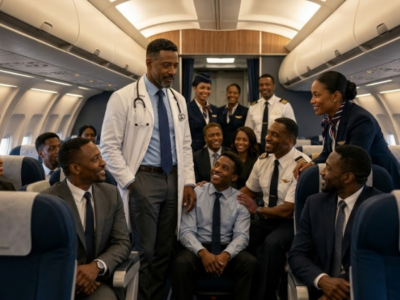
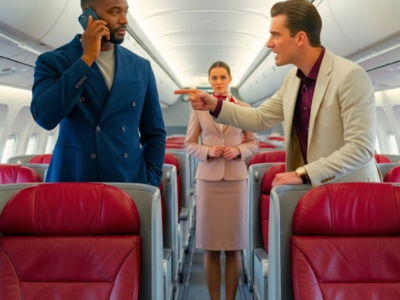
Attendant Slaps a Black Man in First Class — Then the Captain Says, “Welcome, Mr. Taylor”
He thought his badge gave him power. The slap echoed through First Class—but the silence that followed was deafening. Then the Captain’s voice cut through: ‘Welcome, Mr. Taylor.’ And suddenly, everyone knew who was really in charge.
Get your filthy hands off the railing. Are you deaf? Get down now. Look at you.
You reek of poverty. You can’t even afford a bus ticket, let alone breathe near this plane. Security! Security!
There’s an intruder. He looks dangerous.
She snapped her fingers at him like she was shooing away a stray dog.
“Ma’am, my name is Harrison Taylor. I am the owner of this plane.”
Her lips curled in disgust. “You own this?” She laughed and stepped forward. “Get out of here before I have someone drag you out like trash.”
The man stared straight into her eyes. She had no idea he would ruin her career in just ten minutes.
5:30 in the morning, Calabasas, California. The sky was still bruised purple when Harrison Taylor stepped barefoot onto his kitchen tile. The floor was cold. The house was quiet.
It was a five-bedroom ranch — no marble columns, no fountain in the driveway, no iron gates with gold initials. Just a house. A home. The kind of place you’d drive past and never look twice at.
He poured his own coffee, black, no sugar. The mug was chipped on the rim, a faded Air Force logo on the side that he’d carried through three deployments and fourteen years of building a company from nothing. He never replaced it. Some things had earned the right to stay broken.
His dog, Colonel — a mutt he’d rescued from a shelter in Long Beach — padded over and pressed his nose against Harrison’s knee. Harrison scratched behind the dog’s ears without looking up. His other hand swiped through the flight manifest on his tablet.
Departure: Van Nuys Airport. Aircraft: Gulfstream G700. Tail number: NPH1. Destination: Aspen. Passenger count: one.
Him. Harrison Taylor, 52 years old.
Founder and sole owner of Pinnacle Aerospace Holdings — a private aviation and defense tech conglomerate valued at $4.8 billion. Forty-plus jets. Government contracts. A luxury charter division called Pinnacle Elite that flew executives, celebrities, and heads of state.
None of that showed on the outside. Not today.
He pulled on a pair of faded jeans and a plain gray polo. No watch. No chain. No cufflinks. No monogram. He laced up worn sneakers and grabbed a canvas duffel bag from the hallway closet.
This was deliberate. Always had been.
He’d once told a Forbes reporter, “If you need a logo to feel important, you aren’t.” But there was more to it than humility. Harrison tested people. Growing up in Compton as the youngest of four had taught him that the fastest way to see someone’s true character was to remove every visible sign of status.
His mother cleaned office buildings at night. His father drove a city bus for 31 years. Neither ever owned anything with a designer label. They taught him the same lesson: Watch how people treat you when they think you’re nobody. That’s who they really are.
He kissed Colonel on the head, grabbed his keys, and walked out to the driveway. A dusty black Ford F-150 sat under the carport — not a Bentley, not a Range Rover. Just a truck with mud on the wheel wells and a crack in the windshield he kept forgetting to fix.
He drove himself. No driver. No entourage. Just a man and his truck heading south on the 101 toward Van Nuys.
Meanwhile, twenty minutes away, a Gulfstream G700 sat gleaming on the tarmac at Van Nuys Airport. The morning heat was already building. Waves of it rippled off the asphalt like liquid glass. The sharp, metallic smell of jet fuel hung in the air.
Captain Greg Sullivan, 58, was doing his walk-around inspection. He had been flying for Harrison for six years and respected him deeply.
Inside the cockpit, First Officer Derek Adams ran through his pre-flight checklist. In the cabin, flight attendant Candace Moore, 29, moved with precision — adjusting champagne flutes, straightening pillows, misting vanilla fragrance. She had been with Pinnacle Elite for exactly three weeks.
Today she had one instruction: The owner of this aircraft would be boarding. His name was H. Taylor. No photo. No description.
She assumed he would arrive in a black sedan. She assumed he would wear a suit. She assumed wrong.
Harrison’s truck rolled into the private aviation lot at 7:15. He parked in an ordinary spot, grabbed his duffel bag, and walked toward the gleaming jet.
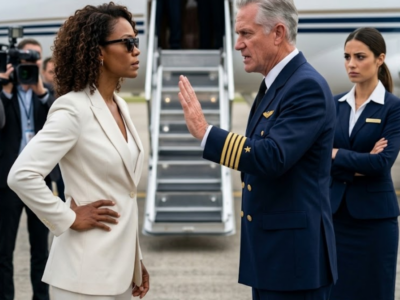
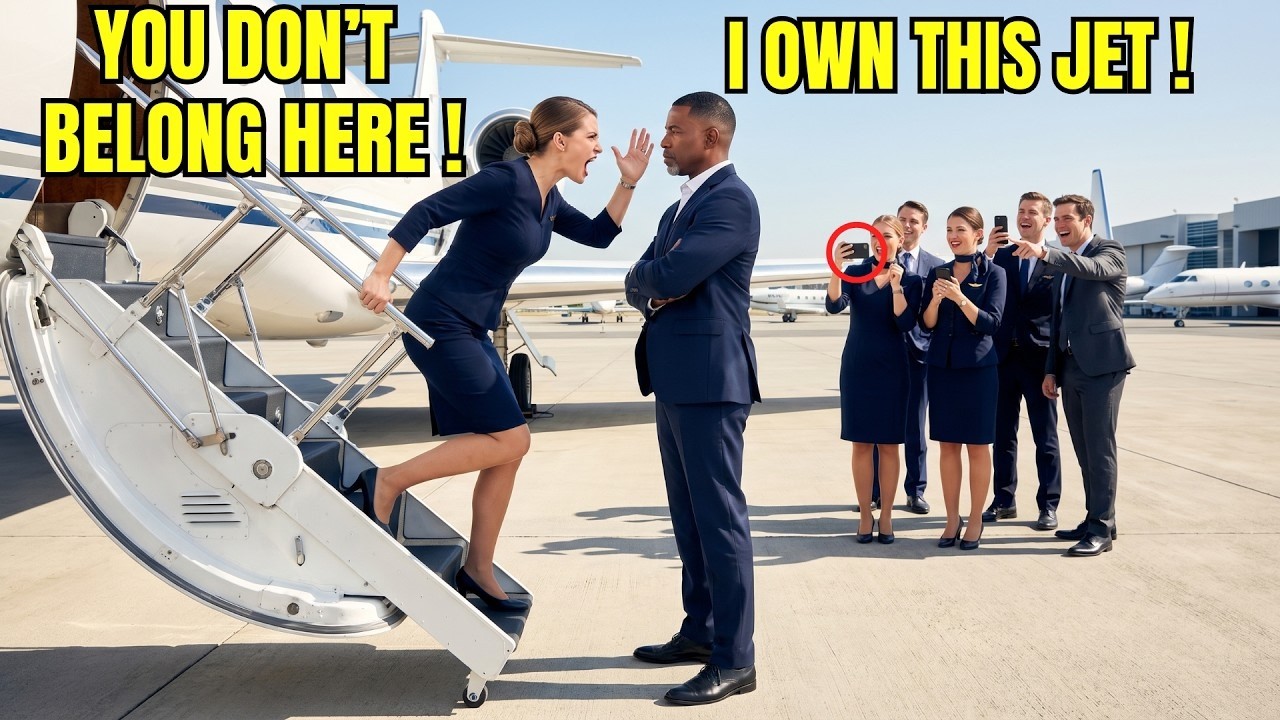
Candace appeared at the top of the air stairs like a guard at a checkpoint. One hand on the railing, the other on her hip. Her eyes scanned him from sneakers to polo and made their judgment instantly.
“Excuse me,” she said sharply. “Where do you think you’re going?”
“Good morning. I’m heading to my seat.”
“Your seat on this aircraft?” She let out a short, mocking breath. “Sir, this is a private charter. I think you’re looking for the main terminal. It’s about a mile that way.”
“I’m not looking for the terminal. My name is Harrison Taylor. This is my aircraft.”
Candace tilted her head. “Your aircraft?” She repeated it slowly, as if tasting something sour. “Right. And I’m the Queen of England.”
She turned to a ground crew member. “Hey, did you let this man onto the tarmac? He’s not authorized to be here.”
Harrison remained calm. “I can show you identification.” He pulled out his wallet and held up his California driver’s license. The address matched the aircraft registration.
Candace barely glanced at it. “Anyone can print a fake ID. Step down from the stairs. I’m not going to ask you again.”
Harrison’s jaw tightened slightly. “Call the charter office. They’ll confirm who I am.”
“I’ll call whoever I want, but you’re not setting foot in this cabin until I say so. Now step down and wait on the tarmac.”
Harrison didn’t move. “I’m going to board my aircraft now.”
“If you take one more step, I’m calling the police. Try me.”
He took the next step.
That was when First Officer Derek Adams stepped out. He immediately sensed something was wrong.
“Candace,” he said carefully, “I think this might actually be Mr. Taylor. Let me check—”
“Go back to the cockpit, Derek,” she snapped. “I’ve got this under control.”
She turned back to Harrison, stepping closer. “I’m going to say this one last time. Get off these stairs. You do not belong on this aircraft. People like you don’t own planes. People like you clean them.”
Harrison moved past her. Candace grabbed his arm, then swung her open palm and slapped him hard across the face.
The crack echoed across the tarmac.
Everything froze.
Harrison slowly turned his head back to face her. His cheek burned red, but his voice remained calm.
“You have no idea what you just did.”
Candace was shaking. “You pushed me! I felt threatened. You put your hands on me. I’m calling the police right now.”
Two airport security officers arrived minutes later. Candace had already transformed into a trembling, teary-eyed victim.
“That man tried to force his way onto the aircraft. He grabbed me. I was terrified.”
The officers approached Harrison with hands near their weapons.
“Sir, step away from the aircraft. Keep your hands where we can see them.”
Harrison stepped down slowly, hands open and visible. “My name is Harrison Taylor. I am the registered owner of this aircraft, tail number NPH1. You can verify it with the FAA or the pilot.”
But they didn’t verify. They listened to Candace’s version instead.
She had no idea that everything she had just done was already being recorded — and that her career was about to end.
Not once did they turn to Harrison and say, “What’s your side?”
The second officer, younger with a thin mustache and nervous eyes, approached him.
“Sir, I’m going to need to pat you down. Standard procedure.”
“Standard for who?” Harrison asked quietly.
The officer patted him down anyway — shoulders, sides, waist, pockets. Harrison stood motionless, jaw set, eyes fixed on a point beyond the officer’s shoulder: the tail of his own aircraft gleaming in the morning sun.
Sixty feet away, Candace watched with her arms crossed and chin high. There was satisfaction on her face. The system was doing exactly what she expected it to do.
Captain Greg Sullivan emerged from the cockpit and hurried down the air stairs. His gray hair caught the wind.
“Officers,” Sullivan said firmly, “I need you to listen to me. That man is Harrison Taylor. He is the owner of this aircraft. I have flown for him for six years. There has been a serious mistake here.”
Candace stepped forward immediately. “Captain, I appreciate your concern, but this man assaulted me. He grabbed me and pushed me. I want to press charges.”
Tears welled up again. Her voice cracked perfectly on the word “assaulted.”
The first officer raised his hand. “Sir, we need to sort this out. Mr. Taylor, would you mind sitting in our vehicle while we take statements? Just to keep things orderly.”
The politeness was fake. The intention was clear.
Harrison didn’t argue. He walked to the white SUV, opened the back door himself, and sat down. The cracked leather seat was warm from the sun. The air inside smelled of stale coffee and sweat. The door shut with a heavy click.
He was not handcuffed, but he was contained.
Through the window, he watched Candace standing at the base of his air stairs, arms crossed, looking comfortable — like she had already won.
Harrison sat still. Behind the calm surface, a lifetime of similar moments pressed against his ribs: the store clerk who followed him at age twelve, the college professor who questioned if he was really enrolled, the investor who shook everyone’s hand except his. A thousand small cuts.
He exhaled slowly, then pulled out his phone.
Inside the cockpit, Derek Adams was whispering urgently into his phone to Lorraine Foster.
“She slapped him, Lorraine. Right across the face. Security’s here. They put him in their vehicle. They didn’t even check the registration. They just believed her.”
Lorraine’s voice came through cold and lethal. “Do not let that woman leave. I’m making calls.”
A local LAPD unit arrived four minutes later. Candace insisted on pressing formal charges. The situation had escalated from an airport misunderstanding into a potential arrest for Harrison Taylor — on his own aircraft.
The LAPD officer approached. Candace reached him first, of course. She told her story again, each version more dramatic than the last. “Lunged” became “charged.” “Grabbed” became “attacked.” “Feared for my life” became “I thought he was going to kill me.”
The officer nodded, wrote everything down, and called her “ma’am” repeatedly.
Then he walked to the SUV. “Sir, I’m going to need you to stay here while we process the complaint. Do you understand?”
“Have you verified who owns this aircraft?” Harrison asked.
“Sir, we’re dealing with an assault allegation right now. Ownership is a separate matter.”
“No,” Harrison replied. “It isn’t.”
Eleven minutes had passed since Harrison first stepped onto the tarmac. In that time, Candace had told her story three times, security had detained the owner without verification, and the LAPD had taken a full statement from the accuser without speaking to the accused.
But something else was happening.
Lorraine Foster had made four phone calls: to Pinnacle’s general counsel, the FAA regional office, Pinnacle’s head of security (who pulled the Gulfstream’s onboard camera footage showing everything in high definition from multiple angles), and finally to Harrison himself.
Harrison’s phone buzzed. He answered.
Lorraine spoke for twelve seconds. He listened, then said one word: “Good.”
He hung up, put the phone away, and folded his hands again. Behind his stillness was pure certainty.
His world was already moving.
The LAPD officer’s radio crackled. His supervisor’s voice came through — clipped and urgent. The conversation lasted fifteen seconds, but it changed everything.
The color drained from the officer’s face. His pen stopped mid-word. He slowly closed his notepad and walked back to the SUV, boots scraping faster across the asphalt.
“Mr. Taylor,” he said, all authority gone from his voice. “I sincerely apologize. You’re free to go immediately.”
Harrison stepped out slowly, straightened his polo, picked up his duffel bag, and brushed the dust off the strap. He refused to hurry.
He turned and walked toward his jet. The sun reflected off the fuselage in a bright white sheet. His sneakers were steady on the tarmac.
Candace was still standing near the air stairs, still convinced she had won — until she realized the entire scene had shifted.
The LAPD officer and both security guards now walked beside Harrison, quietly clearing a path for the owner.
The officer turned to Candace, his voice flat. “Ma’am, Mr. Taylor is the registered owner of this aircraft. Confirmed by the FAA, the charter company, and his legal team. The allegations you reported are inconsistent with available evidence.”
Candace blinked rapidly. “That can’t be… The owner is supposed to be…”
She didn’t finish the sentence. She didn’t have to.
Captain Sullivan stood at the top of the stairs. “The owner, Candace, is the man you just slapped. The man you called trash. The man you had put in the back of a security truck. The man who signs your paychecks.”
Derek stepped forward and held up his phone, showing the company website, Forbes article, Bloomberg profile, and photos of Harrison with the Secretary of Defense.
Candace’s face collapsed through confusion, denial, recognition, and finally raw fear. Her legs weakened. She grabbed the railing to stay upright. The blood drained from her face.
Harrison walked past her without a word and entered the cabin. He sat in his chosen seat in the aircraft he had personally configured.
Then he looked at Candace, still frozen in the galley.
“You are terminated,” he said calmly. “Effective immediately. Your employee file will reflect the following: physical assault of the aircraft owner, gross misconduct, racial discrimination, and filing a false report with law enforcement.”
Each word landed like a nail.
“The security cameras on this aircraft recorded everything. Every word, every lie, including the slap. That footage is already with my legal team.”
Candace broke. Real, ugly, desperate tears came now. She clasped her hands together.
“Mr. Taylor, please… I didn’t know. I swear I didn’t know who you were. It was a terrible mistake. I’m begging you.”
Harrison looked at her, steady and unmoved. The red mark on his cheek had already faded.
His voice had not wavered.
“You didn’t make a mistake. You made a choice. You looked at me and decided I didn’t belong here. That wasn’t confusion, Candace. That was contempt. And contempt has consequences.”
Security escorted her off the jet, down the air stairs, across the tarmac, and into the back seat of the same white SUV Harrison had sat in just minutes earlier. The cracked leather, the stale coffee, the static on the radio. The symmetry was perfect — and it was only the beginning.
The call came before her escort even reached the terminal. Pinnacle Elite’s HR director was already speaking with general counsel. The decision was made. Within the hour, Candace received a formal termination letter by email.
She was sitting on a plastic chair in the airport security office when her phone buzzed. With swollen eyes and mascara streaked down her cheeks, she read the four paragraphs that sealed her fate.
Grounds for termination:
Physical assault of the aircraft owner
Gross insubordination
Racial discrimination
Filing a false police report
Refusal to verify passenger identity
Obstruction of authorized boarding procedures
Effective immediately. No severance. No appeal.
But the termination letter was only the first domino. Pinnacle’s HR department flagged her file in the aviation industry’s shared personnel database — a red flag with devastating notes. In private aviation, reputation is oxygen. That red flag didn’t just close one door. It welded every door shut.
No charter company would touch her. No commercial airline would interview her. Her name had become a warning label.
Candace didn’t know the full extent yet. She was still trying to talk her way out, just like she always had. She called her previous employer for a reference. The response was polite but hollow. She tried two more airlines. One didn’t answer. The other said the position had already been filled — before she even asked about one.
Meanwhile, the two airport security officers who detained Harrison were placed on immediate administrative review. The LAPD officer received a formal reprimand for failing to verify basic facts and showing procedural bias. Their careers were damaged.
All because one woman decided a Black man in a polo shirt couldn’t possibly own a plane.
But Candace wasn’t done making mistakes.
That evening, alone in her Burbank apartment, she recorded a video. With tears and a trembling voice under soft lighting, she claimed she had been wrongfully terminated for simply doing her job. She called it corporate overreaction and cancel culture. She omitted the slap, the racial slurs, the fact that the “intruder” was the owner, and the existence of four security cameras.
She posted it across Instagram, TikTok, Facebook, and X. Within six hours, it had 200,000 views. The comments poured in: “Stay strong, queen.” “Sue them.”
She felt vindicated.
She had no idea the real footage would destroy her narrative in 48 hours.
Two days later, Harrison’s legal team released the unedited security footage from all four cameras. The video was raw, timestamped, and crystal clear.
It showed Harrison walking casually across the tarmac with his duffel bag. It captured every word Candace spoke: “Get your filthy hands off the railing… You reek of poverty… People like you don’t own planes. People like you clean them.” Then the slap — from two different angles.
No ambiguity. No defense.
The footage was sent simultaneously to CNN, MSNBC, and ABC. Within hours, it was everywhere. Someone created the devastating split-screen: Candace’s tearful victim video on the left, the raw security footage on the right.
The internet turned on her instantly. Hashtags like #BillionaireOnHisOwnPlane and #JusticeForHarrison exploded. Her follower count cratered. She deleted her accounts, but screenshots and archives remained.
Harrison’s legal team filed a civil lawsuit against her personally: assault and battery, defamation, intentional infliction of emotional distress, and false light invasion of privacy.
The FAA opened an investigation and permanently revoked her flight attendant certification. The LAPD’s internal affairs division and the district attorney also acted. Criminal charges were filed: misdemeanor battery and filing a false police report.
The criminal trial lasted three days. The jury watched the footage multiple times. They deliberated for less than two hours and returned a guilty verdict on both counts.
The judge sentenced her to 180 days in county jail (30 days to be served), two years probation, 200 hours of community service with civil rights organizations, and mandatory racial bias training. She now carried a permanent criminal record.
The civil lawsuit settled out of court. The public terms included substantial financial damages and a formal public apology written by Harrison’s legal team, which she was required to read on camera.
Harrison held a brief press conference afterward. He announced that part of the settlement would fund the Taylor Foundation — full-ride aviation scholarships for young Black pilots, engineers, and aerospace professionals.
“I didn’t build Pinnacle so that people who look like me would still be asked to prove they belong,” he said.
He wore the same gray polo from that morning.
Where are they now?
Harrison Taylor continues to lead Pinnacle Aerospace Holdings. The company’s valuation surpassed $5 billion. He implemented company-wide implicit bias training and later testified before Congress on racial profiling in private aviation. The Taylor Foundation has already awarded its first scholarships.
Derek Adams was promoted to captain and now leads bystander intervention workshops for new employees.
Captain Greg Sullivan retired with honor, calling the incident one of the most shameful things he witnessed in three decades of flying — not because of what Candace did, but because the system protected the wrong person for ten full minutes.
Candace Moore served her time, completed her community service, and moved to a small town in the Midwest. She works a quiet retail job. The red flag in the industry database follows her everywhere. She can no longer work in aviation.
This story isn’t really about a billionaire getting revenge.
It’s about what happens when someone has the power to fight back — and what happens to the millions who don’t.
Most people don’t own the plane. They don’t have cameras rolling or a legal team on speed dial. They just have to absorb it.
So what do we do?
We be the Derek.
We be the one who picks up the phone and says, “Hold on. I think you might be wrong.”
Because silence isn’t neutral. Silence chooses a side.
Justice was served. But justice shouldn’t have been necessary.
The real victory is that this story was told — so maybe next time, someone pauses before they block the door.