The flight attendant’s attitude towards the Black woman — not knowing she is a billionaire owner of the plane…
The Flight Attendant’s Attitude Towards the Black Woman — Not Knowing She Is a Billionaire Owner of the Plane
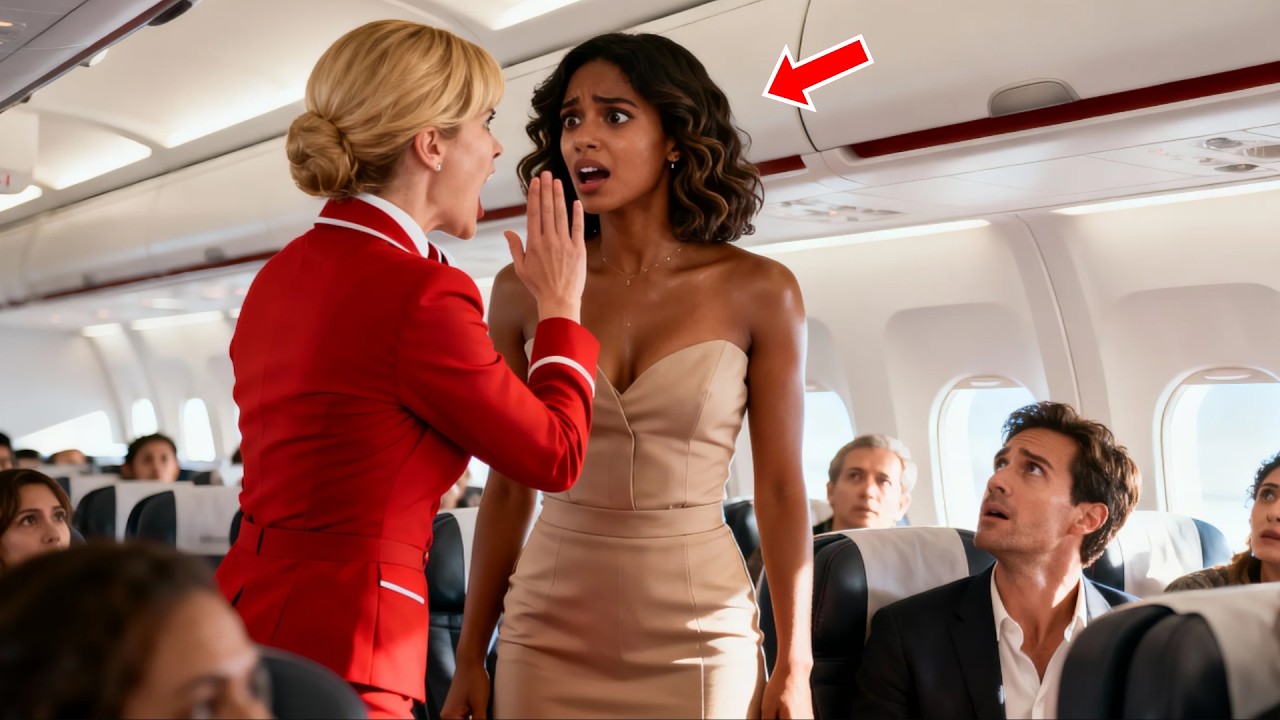
The slap cracked through the first-class cabin like a gunshot.
For one suspended, impossible second, the entire world seemed to stop.
Champagne flutes froze halfway to painted lips. A businessman’s laugh died in his throat. Even the soft hum of the aircraft seemed to retreat beneath the violence of that single sound.
Jessica Montgomery stood in the aisle with her hand still raised, chest rising and falling, eyes blazing with self-righteous fury. Her immaculate blonde hair hadn’t moved. Her lipstick was still perfect. Her uniform still looked as though it had been tailored directly onto her body. Only her expression betrayed the ugliness beneath the polished surface.
“I told you to get out of this seat,” she hissed, leaning over the woman in 1A with the cold delight of someone who had long ago confused cruelty with authority. “This section is for elite passengers. Not trash like you.”
The woman in the gray hoodie didn’t scream.
She didn’t lunge back.
She didn’t cry.
She didn’t even touch her cheek.
Naomi Sterling simply turned her face forward again, as though she were settling after a minor inconvenience. Then, with a calm so eerie it sent a ripple of unease through the cabin, she slipped one hand into her pocket, pulled out her phone, and dialed a number from memory.
When the call connected, her voice was low and steady.
“Captain Hayes,” she said, never taking her eyes off Jessica’s suddenly paling face. “Land the plane. Now.”
A beat.
Then she added, with the same quiet precision one might use to approve a contract or cancel a dinner reservation:
“I’m firing the crew.”
Rain hammered the glass walls of JFK Terminal 4, turning the tarmac beyond into a blurred wasteland of lights, shadows, and silver streaks. The airport pulsed with holiday chaos—rolling luggage, sharp voices over intercoms, espresso machines hissing behind crowded counters, the heavy scent of expensive coffee and wet wool filling the air.
Naomi Sterling barely noticed any of it.
She stood near the gate with the hood of a faded charcoal sweatshirt pulled low over her forehead, one hand gripping the strap of an old canvas duffel bag. She looked like someone who had slept in an airport chair and barely made it to boarding. Her hair was tied back in a careless bun. There was no makeup on her face, no jewelry except a watch hidden beneath her sleeve, no outward sign of money or power or privilege. Just leggings, worn sneakers, and the kind of exhaustion that hollowed a person out from the inside.
This was not the polished Naomi Sterling the world knew.
This was not the woman whose face had stared out from the cover of Forbes only a month earlier beneath the headline about one of the most aggressive aviation acquisitions of the decade.
This was not the billionaire strategist who had just closed a four-billion-dollar merger after forty-eight sleepless hours of negotiations, lawyers, private meetings, and bloodless warfare in glass conference rooms.
This was a woman running on caffeine, fury, and approximately ninety minutes of sleep spread across three days.
She caught her reflection in the dark window by the gate and almost smiled.
No one looking at her now would guess that three hours earlier, the airline she was about to board had become hers.
Not partly hers.
Not symbolically hers.
Hers.
Sterling Airways—its routes, its staff, its debt, its reputation, its failures, its future. Every polished aircraft and every hidden crack in the foundation now belonged to Naomi Sterling.
And tonight, she intended to see what kind of company she had really bought.
The boarding announcement crackled overhead.
“Sterling Airways Flight 9009 to London Heathrow is now boarding Group One and first-class passengers.”
Naomi adjusted the duffel on her shoulder and stepped into line.
There were only a handful of passengers waiting in the premium lane: three men in expensive suits, an older woman draped in diamonds and cashmere, and Naomi in her thrift-store disguise. The contrast was almost comical. The reaction was immediate.
The men looked at her, then at each other.
One of them—slicked-back hair, pinstriped suit, the smug confidence of a man who had never once in his life been told no—leaned toward his companion and muttered just loud enough for Naomi to hear.
“Did they open first class to standby? Economy’s getting bold.”
His friend smirked.
Naomi didn’t react. She had spent her life in rooms full of men like him. Men who mistook wealth for character and access for superiority. Men who assumed that if a woman was quiet, she was weak; if she was casual, she was unimportant; if she was kind, she was soft enough to be ignored.
She handed her boarding pass to the gate agent.
The scanner flashed green.
The young agent glanced down at the screen, then up at her hoodie, then down again. Confusion crossed his face.
“M. Sterling?” he asked carefully.
“That’s me.”
He hesitated for half a second too long.
Then he handed the boarding pass back with a stiff, uncertain smile. “Have a pleasant flight, Ms. Sterling.”
His eyes followed her all the way down the jet bridge.
That was the easy part.
The real test was waiting at the aircraft door.
Jessica Montgomery stood at the entrance of the Boeing 787 like the gatekeeper to some private kingdom she had mistaken for her own.
Tall, flawless, and surgically composed, she embodied the Sterling Airways luxury image with unnerving precision. Her smile for the affluent passengers was warm, silky, and practiced to perfection. She greeted them by name, took coats from their shoulders, offered hot towels and champagne with the ease of a woman who knew exactly how to flatter wealth.
“Welcome aboard, Mr. Henderson,” she purred, taking the pinstriped businessman’s coat as though receiving royal robes. “Seat 2A, just as requested. Let me get your champagne.”
Then Naomi stepped onto the plane.
Jessica’s smile vanished so fast it was almost violent.
No polite greeting.
No “welcome aboard.”
No pretense of courtesy.
She moved directly into Naomi’s path and held out her hand.
“Boarding pass.”
It wasn’t a request. It was a challenge.
Naomi handed it over.
“I’m in 1A.”
Jessica took the paper between two fingers as if it might be contaminated. Her eyes scanned it once, then again, her expression tightening with disbelief. She bent the ticket slightly, inspecting it for an error, a smudge, some technical flaw that would justify what she had already decided the truth must be.
“One A?” Jessica gave a short, humorless laugh. “This has to be a system error. Seat 1A is reserved for full-fare premium passengers. Diplomats. Executives. It’s probably a kiosk mistake.”
“It wasn’t a mistake,” Naomi said quietly. “I booked it this morning.”
Jessica looked her up and down.
Not a glance—a dissection.
Her gaze lingered on the worn sneakers, the faded hoodie, the battered duffel bag. The contempt in her eyes sharpened into certainty.
“Listen,” Jessica said, lowering her voice into something nastier, “I don’t know how you got past the gate. Maybe the agent was distracted. Maybe you slipped through while he was helping actual customers. But economy is in the back. Way back. Rows forty through fifty-eight. So go find an empty seat and stop blocking the aisle.”
Naomi’s patience thinned by a degree.
“I paid for 1A.”
“I don’t need to check anything to know you do not belong in my cabin.”
The words hung in the air like poison.
Behind Jessica, Mr. Henderson was already watching the exchange with visible amusement, champagne in hand, as though the cabin had unexpectedly provided him with live entertainment.
“Problem, Jessica?” he asked lazily.
“Just a little seating mix-up, Mr. Henderson,” Jessica replied, turning sweet again so quickly it was almost nauseating. “Some people see a boarding pass and suddenly think they’re entitled to the penthouse.”
Then she faced Naomi once more, and the smile vanished.
“Move. Now. Or I’ll have security drag you off this aircraft for disrupting the flight.”
Naomi looked at her for a long moment.
She could have ended it right there.
She could have pulled the black titanium identification card from her pocket—the one that would have informed Jessica Montgomery, in no uncertain terms, that she was speaking to the new owner of Sterling Airways.
She could have introduced herself properly.
She could have told Jessica that the company she treated like a private social club had changed hands that afternoon, and that the woman she was humiliating now had the authority to end her career before the boarding door even closed.
She could have.
But Naomi had not boarded this flight to make a point.
She had boarded it to gather proof.
Rumors had been circulating for months—whispers of discrimination, elitism, abuse of passengers, senior crew behaving like petty aristocrats in designer uniforms. Complaints had reached the board, but complaints could be buried. Reports could be softened. Internal reviews could be manipulated.
Naomi wanted the truth unfiltered.
So she stayed in character.
“Check the tablet,” she said, nodding toward the device in Jessica’s hand. “Just check the manifest.”
Jessica exhaled sharply, all theatrical annoyance.
“Fine.”
She tapped the screen with exaggerated aggression, clearly expecting vindication. But then her hand stopped.
Seat 1A.
Passenger name: N. Sterling.
VIP status flag.
No title.
No explanation.
Just a high-priority notation that told Jessica exactly what she did not want to hear: the woman in the hoodie belonged there.
A flicker of uncertainty crossed her face.
Not shame. Never shame.
Just irritation that reality had failed to cooperate with her prejudice.
Finally, she thrust the boarding pass back at Naomi.
“Fine. Sit. But if you disturb the other passengers, if you make a sound, or if that filthy bag touches anyone, you’re out.”
Naomi stepped past her.
Jessica drove an elbow hard into her ribs.
The impact stole Naomi’s breath. She stumbled sideways, the duffel swinging into the side of Mr. Henderson’s seat.
“Watch it,” he snapped, recoiling as though contact with her bag had physically offended him.
“So clumsy,” Jessica muttered, loudly enough for half the cabin to hear. “Animals shouldn’t be let out of cargo.”
A few people laughed.
Naomi said nothing.
She lowered herself into seat 1A—a lie-flat suite of leather, polished wood, and soft amber light—and slid the old canvas bag beneath the ottoman. The luxury around her felt obscene against the ugliness of the last two minutes.
She closed her eyes for a moment.
Seven hours, she told herself.
Just endure seven hours.
But the night was only beginning.
Boarding finished. The cabin settled into the low murmur of expensive comfort—seatbelts clicking, glasses clinking, overhead bins shutting with soft mechanical precision.
Jessica and a younger flight attendant named Sarah began pre-departure service.
Sarah looked nervous, the kind of nervous that suggested she knew exactly what Jessica was doing and hated every second of it. She moved quietly through the cabin with a tray of champagne, offering drinks to each passenger in first class.
“Champagne, Mrs. Gable?”
“Scotch for you, Mr. Henderson?”
Smiles. Laughter. Crystal and silver.
When they reached Naomi’s row, Jessica walked straight past her without turning her head.
No drink.
No water.
No acknowledgment that seat 1A even existed.
Naomi waited a minute, then another. Her throat was dry from recycled terminal air and exhaustion. She watched Jessica return to the galley, uncork another bottle, and resume charming the wealthy passengers in row two as though Naomi were invisible.
Naomi pressed the call button.
A soft chime.
Jessica ignored it.
Naomi pressed again.
Another chime.
Still nothing.
A third time.
A fourth.
Finally, Jessica stalked over and yanked back the privacy curtain with enough force to make the rail shudder.
“What?” she snapped. “What is your emergency? Because unless you’re dying, there is absolutely no reason to keep pressing that button like a child.”
Naomi looked up at her.
“I’d like some water, please.”
Jessica stared.
Then, very slowly, she smiled—not kindly, but with the brittle malice of someone who had just been handed a new opportunity to humiliate.
“We’re currently serving premium passengers,” she said. “There’s a limited supply of bottled water.”
Naomi’s gaze flicked toward the galley, where an entire crate of Evian was visible on the service cart.
“I can see the water from here.”
“That,” Jessica said, leaning in close enough for her perfume to turn suffocating, “is for the guests.”
The word landed like a slap.
“You may have scammed your way into this seat, honey, but you do not get the service. As far as I’m concerned, you’re cargo with a boarding pass.”
Naomi’s eyes hardened.
“I paid for this cabin.”
Jessica gave a short laugh.
“And I wear a uniform. That doesn’t make me a pilot.”
Then her voice dropped to a whisper sharpened like a blade.
“Put your seatbelt on, shut your mouth, and stop embarrassing yourself.”
She turned away, then paused—just long enough to make sure Naomi was watching.
From her apron pocket, Jessica produced a small can of air freshener.
She sprayed it into the space around Naomi’s seat.
Once.
Twice.
A third time.
Then she waved her hand dramatically in front of her nose as if trying to clear some foul odor from the air.
Mr. Henderson chuckled from across the aisle.
“Doing the Lord’s work, Jessica,” he said. “Keeping the riffraff in check.”
A few nearby passengers smiled into their drinks.
Naomi’s fingers tightened around the armrests until her knuckles turned white.
It wasn’t the thirst that hurt.
It wasn’t even the insult.
It was the certainty behind it—the absolute, unshakable conviction Jessica had that she was entitled to strip another human being of dignity because of how she looked. Because the hoodie was faded. Because the sneakers were worn. Because wealth, in Jessica’s mind, had a dress code, and humanity itself seemed to require one.
The intercom chimed before Naomi could answer.
A deep, steady voice filled the cabin.
“Good evening, ladies and gentlemen. This is Captain Robert Hayes speaking from the flight deck. We’re looking at a smooth crossing to London tonight, with an estimated flight time of six hours and forty-five minutes. Sit back, relax, and enjoy the world-class service provided by our excellent crew.”
Naomi looked up at the speaker above her seat.
Robert Hayes.
One of the airline’s oldest captains. A man who had flown for her father when Sterling Airways was still fighting for gate space and credibility. Honest. Competent. Respected. If there was rot in the company, Naomi had never believed it reached him.
Which meant he almost certainly had no idea what was happening ten feet behind his cockpit door.
Naomi slipped her phone from her pocket and typed a single message to her assistant in New York.
Get me the full personnel file for Flight 9009. Crew lead Jessica Montgomery. Pilot Robert Hayes. And put legal on standby.
She hit send.
Then she looked up.
In the galley, Jessica was laughing with Sarah, a flute of passenger champagne in her own hand—another violation, another tiny act of arrogance born from the assumption that no one above her would ever care enough to look closely.
Jessica caught Naomi watching.
With a mocking little smile, she raised the glass in a silent toast and mouthed one word.
Loser.
Then she drained the champagne.
Naomi didn’t blink.
Enjoy it, she thought.
It’s the last drink you’ll ever have on my airline.
Once the aircraft leveled at thirty-five thousand feet, the seatbelt sign blinked off with a cheerful little chime that felt grotesquely out of place.
Outside the windows, the night stretched black and endless, the Atlantic waiting below like a sheet of buried steel. Inside, first class glowed with curated luxury—amber lighting, polished surfaces, linen-draped trays, the hushed confidence of people accustomed to being served before they asked.
For everyone else in the cabin, it was paradise.
For Naomi, it was a front-row seat to institutional rot.
Her stomach had begun to ache with hunger. She had eaten nothing since a protein bar in a conference room sometime that morning—if it was still the same morning; exhaustion had blurred time into something shapeless and cruel. Across the aisle, the dinner service began in earnest.
Sarah pushed the cart forward, and the scent hit Naomi almost painfully: filet mignon with truffle reduction, roasted asparagus, warm sourdough rolls, a mushroom risotto rich enough to perfume the entire cabin.
Silver domes lifted.
Wine was poured.
Passengers murmured approval.
Sarah stopped at Mr. Henderson’s seat with a practiced smile, but Naomi noticed the quick, anxious glance the younger attendant kept throwing toward 1A. She had seen what Jessica was doing. Maybe she had seen all of it. Maybe she had spent the entire flight trapped between fear and conscience.
Jessica, meanwhile, was in her element.
She floated from pod to pod like a hostess at a private gala, all glittering teeth and velvet tones, checking on each passenger with lavish attention. She laughed at bad jokes. Refreshed wine glasses before they were empty. Offered extra bread, extra butter, extra desserts no one needed and no one would refuse.
Then she came to Naomi’s seat.
And kept walking.
No tray.
No menu.
No acknowledgment.
Naomi looked up slowly.
“Excuse me.”
Jessica stopped but did not turn around right away. When she finally did, the annoyance on her face was theatrical.
“Yes?”
“You skipped my meal.”
“No,” Jessica said coolly. “I didn’t.”
Naomi held her gaze. “Then where is it?”
Jessica folded her arms. “You were not assigned a meal.”
“That’s impossible.”
“Not really.” Jessica’s smile sharpened. “Sometimes special inventory isn’t loaded correctly. Sometimes the system flags a passenger incorrectly. Sometimes”—her eyes swept over Naomi’s hoodie again—“someone ends up somewhere they were never supposed to be.”
Naomi looked past her to the galley and saw it immediately: one untouched first-class meal still plated on the service counter.
“You have my meal.”
Jessica didn’t bother to deny it.
Instead, she leaned down until her face was only inches from Naomi’s.
“Let me make something very clear,” she whispered. “I don’t care what glitch got you into this seat. I don’t care what little sob story you tell at the gate. People like you do not walk into spaces like this and get treated like equals. Not on my flight.”
For the first time that night, Naomi felt something cold and dangerous unfurl inside her.
Not anger.
Anger was hot, reckless, immediate.
This was something else.
This was the calm before destruction.
The kind that settled over boardrooms right before a hostile takeover.
The kind that came just before signatures, terminations, and headlines.
Jessica straightened, smiled brightly at an approaching passenger from row two, and reached behind Naomi’s seat to press the call-button reset as if dismissing a nuisance.
Then she turned back and said, in a normal speaking voice meant for anyone listening:
“I can offer you pretzels from economy, if you’d like.”
Mr. Henderson laughed out loud.
Naomi looked up at Jessica for one long, silent second.
Then she smiled.
It was a small smile.
Controlled.
Unreadable.
And somehow that smile disturbed Jessica more than shouting ever could have.
Because in that moment, for the first time all night, Jessica seemed to understand that the woman in 1A was no longer enduring the humiliation.
She was documenting it.
Recording it.
Measuring it.
Letting it reveal itself in full.
And somewhere, just beyond the polished calm in Naomi Sterling’s eyes, something devastating was already in motion.
Dinner service rolled through first class like a private ritual of excess.
Silver domes lifted. Crystal glasses caught the amber cabin light. The scent of butter, seared beef, and expensive wine drifted through the aisle, rich enough to make Naomi’s empty stomach tighten with pain.
Across from her, Sarah stopped at Mr. Henderson’s suite and forced a professional smile onto a face already strained by nerves.
“Mr. Henderson,” she said softly, “would you prefer the steak or the Chilean sea bass this evening?”
Henderson didn’t even bother looking up from his iPad.
“The steak. Rare. And keep the red wine coming.”
“Yes, sir.”
Sarah moved to the next passenger, then the next, her hands steady only because she was trying so hard to make them steady. By the time she reached Row One, there was something like pity in her eyes. She looked at Naomi—really looked at her—and for a brief moment it seemed as though the younger attendant might defy the woman watching from the galley.
She reached for a menu.
Her fingers had barely brushed the cardstock when Jessica’s voice split the air.
“Sarah.”
It landed like a whip crack.
Sarah froze.
Jessica had appeared so quickly it was almost eerie, one hand on the service cart, the other resting against her hip, blue eyes sharp with warning.
“Move the cart to the next section,” she said. “We’re done here.”
Sarah stared at her. “But Jessica… she hasn’t eaten. We still have extra meals.”
Jessica didn’t even blink.
“We don’t waste premium catering on non-revenue passengers.”
The lie was delivered smoothly, almost elegantly, and loud enough for Henderson to hear it.
“She’s probably flying on a buddy pass or some booking glitch. Policy is clear—meals are for paying customers only. If she wants food, she can purchase a snack box from economy later.”
Naomi slowly lifted her gaze.
Her eyes locked onto Jessica’s.
“I paid twelve thousand dollars for this seat,” she said, her voice calm enough to be unsettling. “That price includes meal service.”
Jessica leaned down and planted both hands on the sides of Naomi’s pod, boxing her in, invading her space with the confidence of someone who had spent years getting away with intimidation.
“Listen to me, you little street rat,” she whispered. “I don’t know whose credit card you stole to buy this ticket, but I am not serving you. You make the other guests uncomfortable just by breathing the same air.”
Her smile turned vicious.
“You smell like rain and desperation. So here are your options: sit there quietly and starve, or keep pushing me and I’ll call the captain and tell him you’re becoming belligerent. I’d love to have authorities waiting for you in London.”
For a long second, Naomi said nothing.
She simply looked at Jessica the way one might study a crime scene—carefully, clinically, committing every detail to memory.
Every line in her face.
Every ounce of contempt.
Every syllable of cruelty.
Then Naomi leaned back in her seat and said, very softly:
“Fine. I’m not hungry anyway.”
Jessica smirked, pleased with herself.
“Good choice.”
She snapped her fingers for Sarah to move the cart along.
Dinner service continued. Laughter returned. Cutlery clicked against china. Somewhere in the cabin, someone asked for another glass of Burgundy.
Naomi sat in silence and opened her laptop.
It was not the kind of machine most people recognized on sight. No glowing logo. No consumer branding. No decorative minimalism. The casing was matte titanium, custom-built and reinforced, with biometric locks and encrypted architecture that made most corporate security systems look like children’s toys.
The screen came alive in a cool wash of blue light, reflecting across Naomi’s face as she logged into the acquisition files for Sterling Airways.
Contracts.
Personnel records.
Operational summaries.
HR policies.
She opened the section on customer treatment and anti-discrimination protocols and began reading with the detached concentration of a surgeon deciding where to cut first.
The language was too soft.
Too polite.
Too forgiving.
Too full of loopholes and euphemisms.
By the time she reached the clause on employee conduct toward premium guests, Naomi was already rewriting entire paragraphs in her head. Not revising them. Not improving them.
Weaponizing them.
Across the aisle, Henderson had finished his steak and was now deep enough into the Pinot Noir that his arrogance had turned sloppy. He glanced over the top of his iPad and noticed Naomi’s computer.
His eyes narrowed.
The machine confused him.
In Henderson’s worldview, women in hoodies did not own equipment like that unless they had stolen it from someone who deserved to own it more.
“Jessica,” he called, snapping his fingers as though summoning a servant.
Jessica appeared almost instantly, wine bottle already in hand.
“Yes, Mr. Henderson?”
He nodded toward Naomi’s laptop.
“Look at that machine. Military-grade casing. My firm was prototyping something similar last year.”
Jessica frowned, staring at Naomi’s screen from a distance. She didn’t recognize the interface—Sterling’s internal enterprise management software looked like a blur of encrypted dashboards, legal files, and command panels she had never seen before. To her, it looked suspicious simply because she didn’t understand it.
“You think she stole it?” Jessica whispered.
Henderson gave a drunken, ugly smile.
“I’d bet my portfolio on it. Probably hacked some executive’s cloud account too. People like that don’t buy computers like this. They take them.”
Jessica’s expression sharpened.
“Don’t worry,” she murmured, laying a reassuring hand on his shoulder. “Nothing goes missing on my flight.”
Two hours later, the cabin had fallen into that strange artificial stillness unique to long-haul luxury travel.
The lights had been dimmed to a deep amber hush. Most of first class had converted into private cocoons of blankets, headphones, and sleep. The low drone of the engines became almost hypnotic, a steady metallic lullaby over the Atlantic.
Naomi still couldn’t sleep.
Rage had a way of sharpening the mind long after the body had given up.
She closed the laptop, set it carefully on the tray table, and rose from her seat to use the lavatory. Her canvas bag remained tucked beneath the footrest. The cabin was quiet enough that the soft click of the lavatory door seemed louder than it should have.
Jessica, lounging in the galley and scrolling through her phone, looked up.
She saw Naomi disappear into the restroom.
She saw the occupied light flick on.
Then she looked toward Seat 1A.
And in that instant, something vicious bloomed behind her eyes.
It was reckless.
It was criminal.
It was the kind of decision that destroys lives.
But Jessica Montgomery had spent too many years believing she was untouchable.
She had seniority.
She had allies.
She had history with pilots, gossip on executives, and a talent for weaponizing charm whenever an investigation got too close. Rules were for junior staff and nervous people. Jessica lived above them.
And now she wanted Naomi gone.
Not moved.
Not embarrassed.
Destroyed.
Blacklisted.
Arrested.
Ruined.
Jessica rose from the jump seat and scanned the cabin.
Sarah was in the rear galley.
Most of the passengers were asleep.
The aisle was empty.
Then her gaze landed on Mr. Henderson.
He was sprawled in his lie-flat seat, snoring softly, one arm hanging over the edge of the bedding. On his wrist sat a gold Rolex Submariner, the clasp loosened so it rested only lightly against his skin.
Jessica moved toward him with eerie precision.
She crouched beside the seat.
Slid two fingers under the watchband.
Lifted.
Henderson grunted in his sleep but didn’t wake.
A second later, the Rolex was in her hand.
Jessica’s heart slammed against her ribs.
This was it.
The kill shot.
She didn’t put the watch in Naomi’s bag—that would have been too obvious, too easy to challenge. Instead, she walked to Seat 1A, knelt beside the pod, and slid the Rolex deep into the narrow side pocket built into the suite wall, wedging it between the cushion and the frame. Hidden, but not too hidden. Just buried enough to create the illusion of a desperate, careless thief.
Then she stood, smoothed her uniform, and returned to the galley.
Her hands were shaking.
Not from fear.
From excitement.
Naomi came back a few minutes later, exhausted and unaware, and settled into her seat without noticing anything unusual. She put on her headphones, leaned back, and closed her eyes, trying to force her body into rest.
Thirty minutes passed.
Then Mr. Henderson woke up.
He sat up groggily, rubbed a hand over his face, and reached for the glass of water on his side table. His eyes dropped to his wrist.
And he froze.
His expression changed instantly—from sleepy irritation to confusion, then from confusion to panic.
He patted the blanket.
Checked under the pillow.
Looked at the floor.
Checked the tray table.
“No. No, no, no.”
His voice rose sharply, cutting through the silence.
“My watch! Jessica!”
The scream ripped through first class like an alarm.
Passengers jerked awake. Blankets shifted. Eyes blinked open in confusion.
Jessica came rushing out of the galley, every inch the picture of alarmed professionalism.
“Mr. Henderson? What happened?”
“My Rolex!” he shouted, face reddening. “It’s gone! I had it on when I fell asleep. It’s a forty-thousand-dollar watch!”
Jessica dropped to her knees beside his pod, searching the carpet with theatrical urgency.
“Are you sure it didn’t fall into the bedding? Did you check under the blankets?”
“I checked everything!”
Then Henderson’s face hardened.
Slowly, dramatically, he turned and pointed across the aisle.
At Naomi.
“It was her.”
The words hit the cabin like poison.
Naomi pulled off her headphones, eyes narrowing.
“She’s the only one who’s been moving around,” Henderson said, voice trembling with righteous fury. “She got up while I was asleep. I saw her shadow pass by. She took it.”
Jessica rose to her feet and turned toward Naomi with perfect, false regret painted across her face.
The cabin went silent.
Every eye fixed on the woman in the gray hoodie.
“Well,” Jessica said softly, “that explains a lot.”
Naomi stood.
“Excuse me?”
“I didn’t touch his watch,” she said, voice clipped and steady.
“Sit down,” Jessica snapped. “Mr. Henderson is a Diamond Medallion member. He doesn’t just lose things.”
Naomi stepped into the aisle.
“And what exactly is that supposed to mean?”
Jessica folded her arms.
“It means you fit the profile.”
Naomi stared at her.
“What profile is that?”
Before Jessica could answer, Henderson did it for her.
“The profile of a thief,” he spat. “Look at you. You probably bought that ticket with a stolen credit card just to get up here and rob people blind. Search her.”
Naomi’s expression went cold.
“You have no right to search me.”
Jessica drew herself up to full height, puffing her chest with authority.
“I am the lead crew member on this aircraft. When a felony occurs in international airspace, I have every right to secure the cabin and investigate.”
Then she shouted toward the rear galley:
“Sarah! Get the restraints ready!”
Sarah appeared at the curtain, horrified.
“Jessica—”
“Now!”
Naomi’s voice dropped, lower and sharper than before.
“You are making a catastrophic mistake.”
Jessica laughed.
“Am I?”
“If you touch my property,” Naomi said, “you are violating federal aviation law and Sterling Airways corporate policy section 4.2.”
Jessica’s eyes flashed with mockery.
“Listen to her. Quoting policy like a little lawyer.”
She thrust out a hand.
“Give me the bag.”
“No.”
Jessica lunged before Naomi could react.
She shoved past her, yanked the canvas duffel from beneath the seat, and ripped the zipper open in one brutal motion. Naomi reached for it.
“Don’t—”
Jessica shoved her backward.
Naomi stumbled hard into the pod as Jessica flipped the bag upside down and dumped its contents directly into the aisle.
Clothes.
Toiletries.
Chargers.
Documents.
A stack of thick legal binders that hit the carpet with a heavy slap.
Passengers stared as Naomi’s belongings spilled out at their feet.
Jessica kicked through them with the toe of her shoe.
“No watch.”
“Check her pockets!” Henderson barked. “She’s probably wearing it.”
Jessica looked up.
“Stand up and empty your pockets.”
Naomi was shaking now, but not with fear.
This was rage in its purest form—cold, focused, almost surgical.
“You have humiliated me,” she said quietly. “You denied me food. You searched my belongings without cause. And now you are framing me.”
Jessica gave a sharp, mocking laugh.
“Framing you? Please. I’m protecting my passengers.”
Then she turned back to Naomi’s seat.
With a theatrical flourish, she ripped the cushion loose, tore off the headrest, and plunged her hand into the side pocket of the suite.
For one heartbeat, the cabin held its breath.
Then Jessica’s face lit with triumph.
“Aha.”
She pulled out the Rolex.
The gold gleamed beneath the cabin lights.
A collective gasp swept through first class.
Henderson sat bolt upright, vindicated and vicious.
“I knew it,” he snarled. “I knew it the second I saw her.”
Jessica held the watch aloft like a trophy. Her smile was ugly now—wide, hungry, almost feral.
“Caught red-handed.”
Naomi stared at the Rolex in silence.
Then she lifted her eyes to Jessica’s face.
“You planted that.”
Jessica recoiled in theatrical outrage.
“Liar!”
Her voice cracked with hysteria, but it only made her performance louder, more dangerous.
“You are a pathological liar and a thief. I should have you taped to your seat right now.”
Naomi took one slow step forward.
“Do it,” she said.
Jessica blinked.
“Call the captain. Right now. Bring him back here. I want to speak to Robert.”
That made Jessica’s face darken instantly.
“You do not get to call the captain by his first name.”
She moved closer, adrenaline making her reckless.
“You are trash,” she hissed. “Do you hear me? Trash.”
She was so close now that Naomi could feel the heat of her breath, could see the tiny flecks of spit at the corner of her mouth, could smell the champagne she’d been drinking from bottles meant for passengers.
“Get out of my face,” Naomi said.
“Or what?”
Jessica smiled.
“What exactly are you going to do? You’re nobody.”
That was the moment everything broke.
Jessica raised her hand—not yet to strike, perhaps only to jab a finger into Naomi’s chest, perhaps to shove her one last time. But the gesture came fast, wild, and aggressive.
Naomi flinched on instinct, lifting an arm to block.
Jessica saw the movement and snapped.
“Don’t you touch me—”
The slap exploded through the cabin.
It was hard.
Deliberate.
Violent enough to whip Naomi’s head to the side.
Silence followed.
Not ordinary silence.
The kind of silence that feels alive.
The kind that comes after a gunshot, or a verdict, or the moment before a building collapses.
Henderson stopped talking.
A woman in Row Two covered her mouth.
At the back of the cabin, Sarah stood frozen, both hands pressed over her lips in horror.
Naomi didn’t move.
Her cheek burned.
Her head remained turned to one side for a long, unbearable second.
Then, slowly—terrifyingly slowly—she turned back to face Jessica.
There were no tears in her eyes.
No panic.
No humiliation.
No fear.
Only something infinitely worse.
A dead, glacial stillness.
The look of a predator that had just been handed a legal reason to destroy.
Jessica took a half-step back.
Naomi touched her cheek once, almost absently, then lowered her hand.
When she spoke, her voice was barely above a whisper.
“You just assaulted a passenger.”
Jessica’s expression flickered.
For the first time all night, there was a crack in her certainty.
But instead of retreating, she doubled down.
“Self-defense,” she snapped, turning toward the other passengers. “She lunged at me. You all saw it. She lunged at me.”
She didn’t.
“She didn’t move.”
The voice came from seat 2D.
It was the older woman in diamonds—the one who had watched most of the ordeal in cool, aristocratic silence from behind a silk sleep mask. Now the mask rested in her lap, and her gaze was fixed on Jessica with the brittle precision of someone who had just decided she’d seen enough.
“She didn’t touch you, darling,” the woman said, her tone almost gentle. “You slapped her.”
The words dropped into the cabin like a judge’s gavel.
Jessica went white.
She turned sharply, eyes darting from face to face, searching for support, for outrage, for anything that would restore the narrative she had been controlling for the last several hours. But the mood in first class had changed. The passengers were no longer entertained. No longer smug. No longer safely removed from the ugliness they had allowed to unfold.
Now they looked uneasy.
Now they looked afraid.
Naomi reached into the pocket of her hoodie.
Jessica flinched so violently it was almost absurd, as if she expected Naomi to pull a weapon.
Instead, Naomi drew out a phone.
Not a sleek consumer smartphone. Not anything sold in airport electronics stores or carried by ordinary travelers. This was a matte-black satellite handset with military-grade encryption and direct executive access protocols—one of the handful of devices on earth capable of making secure calls from virtually anywhere on the planet.
Jessica stared at it.
“What are you doing?” she snapped, though her voice was already fraying. “Put that away.”
Naomi ignored her.
She pressed one button.
Then she lifted the phone to her ear and spoke with the calm of someone ordering a boardroom to clear.
“Captain Hayes,” she said.
Jessica’s breath caught.
Naomi’s eyes never left hers.
“This is Naomi Sterling. Code Alpha-Zero-One. I am in seat 1A.”
There was a beat as she listened to the voice on the other end.
“Yes,” Naomi said. “I’m serious.”
Another pause.
Then her expression hardened into something glacial.
“Secure the cockpit. Then make an announcement. We are diverting the aircraft.”
Jessica stopped breathing.
Sterling.
The name hit her like blunt-force trauma.
Naomi lowered the satellite phone and sat back down in the half-destroyed shell of her first-class suite, surrounded by the contents of her bag scattered across the carpet like evidence from a crime scene.
She folded her hands in her lap and looked up at Jessica.
“You should start praying,” she said quietly. “Because this plane is turning around. And when we land, you’re not going home.”
The air inside first class changed.
Not metaphorically.
Not subtly.
It changed the way the atmosphere changes just before a lightning strike—heavy, electric, impossible to ignore. Even the engine noise seemed different now, louder somehow, more ominous, as if the aircraft itself had become aware that something irreversible had begun.
Naomi slipped the satellite phone back into her pocket. Her expression gave away nothing.
Jessica stood in the aisle with her chest heaving, one hand still flexing from the slap she’d delivered. She let out a brittle laugh—too high, too fast, too desperate.
“You think I believe that?” she said, scanning the cabin for agreement. “She’s bluffing. She’s insane. You can’t just call the cockpit. You can’t just—”
Her voice broke.
Across the aisle, Henderson clutched his bare wrist and stared at Naomi with a look that was no longer smugness, but unease. The certainty had drained from him now, replaced by the dawning terror of a man realizing he might have backed the wrong monster.
“Jessica,” he muttered, lowering his voice, “maybe we should just restrain her and deal with it on the ground. Don’t escalate.”
“No.”
Jessica whipped around to him, her composure fracturing by the second.
“No. She assaulted me. She threatened the safety of this flight. I am in charge here.”
And then the floor dropped.
It wasn’t a routine banking turn.
It wasn’t turbulence.
It was violent.
The nose of the Boeing 787 dipped sharply, throwing a wave of startled cries through the cabin as the engines changed pitch and the aircraft rolled into an aggressive descent. Overhead bins rattled. Glassware trembled in the galley. The deep mechanical hum of cruise altitude transformed into something harsher, angrier—a guttural roar of thrust reduction and deployed spoilers.
Then came the sound that made every flight attendant on board go cold.
Bing. Bing. Bing.
Three rapid chimes.
Cabin emergency.
Jessica grabbed the back of Henderson’s seat to steady herself, eyes widening as the aircraft banked hard.
“What—?”
The intercom clicked on.
But this time there was no smooth, reassuring captain’s voice meant to calm nervous travelers. When Captain Robert Hayes spoke, his tone was so cold it seemed to strip the oxygen from the air.
“Flight attendants, take your seats immediately. We are initiating an emergency diversion to Boston Logan International Airport. Prepare the cabin for arrival. Law enforcement has been notified and will meet the aircraft on landing.”
Jessica’s mouth fell open.
“Boston?” she whispered. “No, no—that’s not right. We’re going to London.”
She spun toward Sarah, who was already fumbling into the jump seat, face pale with fear.
“Why is he listening to her?”
“Jessica, sit down!” Sarah cried, buckling herself in. “He said emergency diversion!”
But Jessica was too far gone now—too panicked, too furious, too convinced that authority still belonged to her.
“No!”
She ripped the interphone from the wall and punched in the cockpit code with shaking fingers.
“Captain Hayes, this is lead flight attendant Montgomery,” she said breathlessly. “There is no need to divert. I have the situation under control. The passenger is restrained—”
Nothing.
No answer.
The line was dead.
The cockpit had locked her out.
Naomi sat calmly in seat 1A, fastening her seatbelt with deliberate precision while the plane carved through cloud and darkness on its way back to the East Coast. She looked up at Jessica, who was still swaying in the aisle as the aircraft descended.
“You should strap in,” Naomi said. “Federal Aviation Regulation 121.391 requires all crew to be seated during emergency descent. You’re collecting violations by the second.”
“Shut up!”
Jessica hurled the receiver against the wall. It bounced off the paneling and clattered to the floor.
“You did this,” she screamed. “I don’t know who you manipulated or who you slept with to get that number, but you are going to rot in prison.”
Then, finally, she stumbled into her jump seat and buckled in with trembling hands.
Across the cabin, her eyes never left Naomi.
Even now—even after the diversion, after the dead line from the cockpit, after the captain had ignored her entirely—Jessica still believed she could win. In her mind, she was the wronged employee, the heroic crew leader containing a dangerous passenger. The police would board. They would see the watch. They would hear Henderson’s testimony. They would take one look at Naomi in her hoodie, at the chaos in the aisle, at the red mark on Jessica’s face where Naomi had never actually touched her, and they would choose the easier story.
That was what Jessica still believed.
The descent was brutal.
The aircraft punched through heavy cloud and turbulence, shuddering so hard the cabin lights flickered. Passengers clutched armrests. Someone in row three whispered a prayer. In the galley, unsecured champagne flutes rattled like bones in a drawer.
Only Naomi remained perfectly still.
She sat by the window, eyes on the darkness beyond the glass, watching the first scattered lights of the American coastline emerge below like embers through fog.
Twenty minutes later, the landing gear deployed with a heavy mechanical thud.
The runway lights of Boston Logan rushed up to meet them.
The 787 slammed onto the tarmac hard enough to wrench gasps from half the cabin. Reverse thrusters roared, loud and savage, and the aircraft shuddered as it decelerated across the rain-slick runway.
But it didn’t taxi to a gate.
Instead, the plane rolled to a stop on a remote section of the airfield, far from the terminal, isolated beneath the flashing wash of emergency lights.
Outside the windows, the night had turned red and blue.
Jessica unbuckled immediately and stood, smoothing her skirt with trembling fingers. She dragged her customer-service mask back over her face, but her eyes were manic now, bright with panic and delusion.
She picked up the PA handset.
“Ladies and gentlemen,” she announced, her voice shaking only slightly, “please remain seated. We have landed due to a security threat posed by the passenger in 1A. Local authorities are boarding to remove her. We apologize for the inconvenience.”
Then she turned to Naomi and smiled.
A nasty, triumphant little smile.
“Game over, sweetie.”
Naomi said nothing.
The forward cabin door hissed open.
Cold night air rushed into the aircraft, carrying the smell of rain, jet fuel, and wet concrete.
Then the first figures boarded.
Not just airport security.
Four Massachusetts State Police officers came up the stairs first, broad-shouldered and grim-faced in dark uniforms. Behind them were two men in tailored black suits with earpieces and hard federal eyes.
FBI.
And finally, stepping onto the aircraft with his cap tucked beneath one arm, came Captain Robert Hayes.
Jessica moved instantly, practically running to meet them.
“Officers, thank God,” she said breathlessly, pointing toward Naomi. “She’s right there. She assaulted me, she stole a passenger’s Rolex, and she threatened the safety of the flight.”
The lead state trooper looked at her.
Then at Naomi.
And did not move toward Naomi.
Captain Hayes stepped past all of them.
He didn’t even glance at Jessica.
He walked straight down the aisle with the heavy, unhurried gravity of a man carrying thirty years of loyalty, shame, and fury on his shoulders. His silver hair was damp from the rain outside. His face looked carved from stone.
He stopped at seat 1A.
Naomi was standing now, one hand resting lightly on the torn leather edge of the suite Jessica had destroyed.
There was a red mark still visible on her cheek.
Captain Hayes drew himself upright.
Then, in full view of every passenger in first class, every police officer, every federal agent, and Jessica Montgomery herself, he stood at attention.
“Ms. Sterling,” he said, his voice thick with controlled anger and humiliation. “I am profoundly sorry. I got here as fast as I could.”
The silence that followed was absolute.
Henderson’s mouth fell open.
The woman in diamonds blinked once and sat back slowly in her seat.
Jessica didn’t move.
It was as if her mind had simply stopped functioning.
Naomi stepped into the aisle.
“Thank you, Robert,” she said quietly. “This is not your fault.”
Jessica made a small choking sound.
“Captain?” she said. Her voice was tiny now, almost childlike. “What are you doing? She’s the suspect.”
Captain Hayes turned to look at her.
The fury in his face was so complete it made the cabin feel colder.
“Ms. Montgomery,” he said, “you are relieved of duty. Effective immediately.”
Jessica laughed—a broken, disbelieving sound.
“Relieved? Robert, you can’t relieve me. I’m the lead. She stole a watch. Mr. Henderson saw it.”
“He saw nothing,” Naomi said.
Then she reached into the pocket of her hoodie and removed a black metallic card.
Not a driver’s license.
Not a boarding pass.
A Sterling Airways executive identification card—matte black, edged in brushed gold, embossed with the airline’s winged crest.
She held it up so the cabin could see.
“My name is Naomi Sterling,” she said, and her voice carried all the way to the rear galley. “My father was Arthur Sterling, founder of this airline. As of four o’clock this afternoon, I am the sole owner and CEO of Sterling Airways.”
The color drained from Henderson’s face so quickly he looked embalmed.
The woman in diamonds actually gasped.
Jessica staggered backward until her spine hit the bulkhead.
“No,” she whispered. “No, that’s not possible. You’re lying. You were wearing a hoodie.”
Naomi took a step toward her.
“I was testing my product,” she said. “And I found a defect.”
The words landed like a blade.
Then Naomi turned to the officers.
“This woman assaulted me. She planted stolen property in my seat to frame me for a felony. I want her arrested.”
Jessica’s panic finally became visible.
“You can’t prove that!”
“Actually,” one of the FBI agents said, stepping forward, “we can.”
He held up a tablet.
“Miss Sterling’s laptop has been recording audio and video since she opened it. It’s equipped with an executive security protocol that activates motion capture whenever the owner steps away.”
Naomi’s gaze never left Jessica.
“It recorded everything.”
The agent tapped the screen and turned the tablet outward so the first-class cabin could see.
On the footage, the cabin was dim and quiet. Naomi rose from her seat and disappeared toward the lavatory. A few seconds later, Jessica entered the frame. She looked around. Reached into her pocket. Pulled out the gold Rolex. Slid it into the side pocket of Naomi’s suite. Smirked. Patted the cushion into place.
Then walked away.
The gasp that tore through the cabin this time was not polite shock.
It was revulsion.
Henderson stared at the screen, then at Jessica, then back at the screen as if his brain could not reconcile the image with the woman he had spent the last several hours defending.
“You,” he whispered. “You had it the whole time.”
Jessica burst into tears.
Mascara ran in black streaks down her face, carving her perfect composure into something grotesque.
“I was trying to help you,” she sobbed. “She didn’t belong here. Look at her. She’s trash. I was protecting the integrity of the cabin.”
Naomi’s voice dropped low and lethal.
“There is no integrity in this cabin. There is only cruelty—and the people who excuse it when it’s convenient.”
Then she turned to the state troopers.
“Get her off my plane.”
The lead trooper stepped forward and pulled a pair of steel handcuffs from his belt.
“Jessica Montgomery,” he said, “you are under arrest for assault, filing a false report, and interference with flight operations. Turn around.”
“No!” Jessica screamed, stumbling backward. “You can’t do this! I’m senior crew. I know the union rep. Captain Hayes—help me!”
Captain Hayes looked at her with open disgust.
“You disgraced the uniform,” he said. “Do not speak to me.”
The handcuffs snapped around Jessica’s wrists with a cold metallic click that seemed to echo through the whole cabin.
She thrashed.
Sobbed.
Begged.
As the officers dragged her down the aisle, she turned desperately toward Henderson.
“Please,” she cried. “Tell them I’m a good person.”
Henderson turned his face away.
He wouldn’t even look at her.
A moment later, Jessica was gone—marched down the portable stairs into the storm of red and blue lights waiting on the tarmac below. Rain lashed the pavement. Police cruisers flashed against the wet concrete. The woman who had strutted through first class like a queen was now bent over in handcuffs, stumbling toward the back of a squad car under the glare of airport floodlights.
Naomi stood at the doorway and watched her go.
She felt no satisfaction.
No triumph.
No rush of revenge.
Only exhaustion.
Then she turned back to the cabin.
Silence met her.
The passengers stared as if they were seeing a ghost—or a verdict made flesh. Some looked ashamed. Some terrified. Some merely stunned that the woman they had dismissed as disposable now stood before them as the most powerful person in the company whose luxury they had taken for granted.
But Naomi wasn’t looking at all of them.
She was looking at Henderson.
She crossed the aisle slowly.
And for the first time that night, the man who had laughed at her, mocked her, and called for her to be searched actually flinched.
“Miss Sterling,” he stammered, sweat gathering at his temples—
Henderson looked like a man who had aged ten years in ten seconds.
A sheen of sweat glistened across his forehead. The arrogance that had sat so comfortably on him all night was gone now, peeled away to reveal something smaller and weaker underneath.
“Miss Sterling,” he stammered, voice shaking. “I—I had no idea. About the watch. About any of this. I never would have—”
Naomi cut him off with a look so cold it stopped him mid-sentence.
“You judged me because of my clothes,” she said.
Her voice was quiet, but it carried through the cabin with surgical precision.
“You looked at a woman in a hoodie and decided she had to be a thief. You watched me be insulted, denied food, denied water, humiliated in front of a cabin full of strangers—and you enjoyed it. You encouraged it.”
Henderson swallowed.
“I’d like to apologize,” he said weakly.
“Save it.”
The words landed like a door slamming shut.
Naomi turned away from him and looked to Captain Hayes.
“Have ground crews refuel us,” she said. “We’re continuing to London. I have a meeting in the morning.”
Hayes nodded without hesitation.
“Yes, ma’am.”
Naomi glanced toward the galley, now conspicuously empty without Jessica’s poisonous presence infecting every inch of it.
“We’re short one flight attendant.”
“I can handle service myself, Miss Sterling,” Captain Hayes said, the ghost of a smile tugging at the corner of his mouth. “Or Sarah can. She tried to stop Jessica.”
Naomi looked toward the jump seat.
Sarah was still buckled in, pale and trembling, as if her body hadn’t yet realized the danger had passed. She looked about twenty-three, exhausted and frightened and completely overwhelmed by the last several hours.
Naomi walked toward her.
“Is that true?” she asked. “You tried to help?”
Sarah nodded quickly, eyes glassy.
“I did, ma’am. I tried to serve you. I tried to stop her. She wouldn’t let me.”
For the first time that night, something softened in Naomi’s expression.
“Then congratulations,” she said. “You’re the new lead flight attendant.”
Sarah blinked.
“What?”
Naomi gave her a tired half-smile.
“You heard me. Promotion effective immediately. Now get this cabin some water. They all look thirsty.”
A nervous laugh rippled through first class—small, shaky, but real. The kind of laugh that comes after surviving a car crash.
Sarah unbuckled herself with trembling fingers and stood, still stunned.
“Yes, ma’am,” she whispered.
And just like that, the cabin began to breathe again.
Two days later, rain washed the glass walls of Sterling Airways’ London headquarters in silver streaks.
Inside the executive boardroom overlooking Heathrow, the air was cool, dry, and painfully clean. The room smelled faintly of polished wood, espresso, and expensive legal paper. A long mahogany table stretched beneath pendant lighting like an altar built for corporate executions.
At the head of it sat Naomi Sterling.
The hoodie was gone.
So were the sneakers, the messy bun, the exhausted traveler disguise. In their place was the woman the business world actually knew: a billionaire CEO in a razor-sharp black blazer, silk blouse, and heels that clicked like warning shots across marble floors. Her hair was pulled back in a severe, elegant knot. Diamond studs flashed at her ears. Her posture was perfect.
She looked less like a person and more like a verdict.
Across from her sat Jessica Montgomery.
Without the navy Sterling Airways uniform, she looked smaller somehow—less polished, less untouchable. She wore civilian clothes now: jeans, a cream sweater, and the expression of a woman who had not slept since the handcuffs went on. Her makeup was minimal, her hair hastily tied back, her hands clenched white in her lap.
Beside her sat a union representative named Greg, a nervous man in a navy suit with too many folders and not nearly enough leverage.
“Ms. Sterling,” Greg began, clearing his throat and arranging papers that wouldn’t save anyone. “While the events on Flight 9009 were deeply unfortunate, we believe immediate termination would be excessive. Jessica has ten years of service with the airline. This appears to have been a stress-induced incident. We are asking the company to consider suspension, mandatory counseling, and anger management intervention in lieu of dismissal.”
Naomi didn’t even look at him.
Her gaze remained fixed on Jessica.
“Stress-induced,” she repeated.
The words were so flat they sounded almost bored.
Then she slid a thick file across the table.
It stopped in front of Jessica with a heavy papery thud.
“I spent the last forty-eight hours reviewing your personnel history,” Naomi said. “Do you know what I found?”
Jessica stared at the file as if it might explode.
“Open it,” Naomi said.
Jessica hesitated.
“Open it.”
Hands trembling, Jessica lifted the cover.
The file was thick enough to break a wrist.
“Sixteen formal complaints in three years,” Naomi said, not glancing at a single note. She knew the contents by heart. “Racial profiling. Verbal abuse. Harassment of elderly passengers. Unauthorized upgrades for personal friends. Repeated allegations of discriminatory treatment toward customers you deemed ‘not first-class material.’ And then there’s the theft of airline property—miniature liquor bottles found in your carry-on during a random check last year. A matter that, mysteriously, disappeared before discipline could be issued.”
Jessica’s breathing turned shallow.
Naomi leaned forward, resting both hands on the table.
“You didn’t snap on that aircraft,” she said. “You revealed yourself. That flight didn’t create a monster. It exposed one.”
Greg shifted in his chair.
“Ms. Sterling, with respect—”
“No.”
The single syllable sliced through the room.
Naomi finally looked at him, and Greg visibly regretted speaking.
“This is not a labor dispute,” she said. “This is not a misunderstanding. This is not a valued employee having one bad day. This is a woman who used a uniform, a badge, and ten years of unchecked authority to terrorize people she believed were beneath her.”
Then she looked back at Jessica.
“The only thing unusual about Tuesday night,” Naomi said softly, “is that this time you picked the one passenger who could stop you.”
Jessica’s eyes filled.
“I said I was sorry,” she whispered.
Naomi’s face hardened.
“If you had known it was me?”
Jessica looked down.
The silence was answer enough.
Naomi’s palm hit the table with a crack so sharp Jessica physically jumped.
“That,” Naomi said, voice rising for the first time, “is exactly the problem.”
The room went still.
“You should not need to know someone is wealthy to treat them like a human being. You should not need to know someone owns the airline before you decide not to starve them, assault them, or frame them for theft.”
She stood up and walked to the rain-streaked windows overlooking the runway, her reflection moving across the glass like a shadow in tailored black.
“If I had been a student,” she said, “or a single mother, or a woman scraping together savings for one nice seat on one hard day—if I had been anyone without power—you would have ruined my life and gone back to pouring champagne before breakfast.”
She turned.
“You are terminated effective immediately for gross misconduct, assault, falsifying an in-flight theft allegation, and conduct unbecoming of any employee of Sterling Airways.”
Greg bristled.
“We will fight this.”
Naomi smiled.
It was not a kind smile.
“No, Greg,” she said. “You won’t.”
She walked back to the table and placed one manicured finger on the folder.
“Because if you drag this into a labor hearing, I will release the cabin footage. All of it. The slap. The planted watch. The abuse. The denial of food and water. Every frame. Every word.”
Greg’s face drained.
“I will let every news outlet in the world run with it,” Naomi continued. “I will let every passenger with a social media account dissect it frame by frame. And then I will invite them to ask why the union chose to spend its resources defending a woman caught on camera planting evidence on a passenger.”
Greg opened his mouth.
Then thought better of it.
Naomi’s attention returned to Jessica.
“But your employment status is the least of your problems.”
Jessica’s head snapped up.
“What does that mean?”
Naomi folded her hands.
“It means I have already shared the police report and supporting evidence with the relevant authorities in both the United States and the United Kingdom. It means the FAA, TSA, and multiple aviation oversight bodies now have your name. It means every major carrier that requests a misconduct reference check will receive one.”
Jessica went still.
“No,” she whispered.
“Yes.”
“No, you can’t do that.”
“I can,” Naomi said. “And I did.”
Tears spilled down Jessica’s face.
“That means I can’t work for another airline.”
Naomi held her gaze.
“That means you can’t be a flight attendant,” she said. “You can’t work a gate desk. You can’t touch customer-facing aviation operations without that incident following you like a second skin.”
Jessica’s mouth trembled.
“Flying is all I know.”
Naomi’s expression did not move.
“Then you should have respected the privilege of doing it.”
Jessica broke.
The sob that came out of her sounded ugly, stripped raw of vanity and control.
“I have rent,” she said. “Bills. What am I supposed to do?”
Naomi looked down at the papers in front of her as if the answer did not concern her in the slightest.
“I suggest you buy a bus pass,” she said. “I hear ground transportation is less exclusive.”
Then she pressed a button on the conference table.
“Security.”
The doors opened almost immediately.
Two corporate security officers stepped into the room.
“Escort Ms. Montgomery out,” Naomi said. “Collect her badge, her company credentials, and any property still in her possession.”
Jessica stood on shaky legs, as if her body no longer belonged to her.
For one last moment, she looked at Naomi—not with hatred now, not even with anger, but with the hollow, stunned disbelief of someone watching their life collapse in real time.
“Please,” she whispered.
Naomi didn’t answer.
The guards took Jessica by the arms and led her toward the door. Her crying echoed down the hallway long after she disappeared from sight, bouncing off glass and stone and polished corporate perfection.
Then the doors shut.
Silence.
Naomi let out a slow breath and sat back down.
Captain Hayes, who had stood quietly near the wall as a witness, stepped forward.
“That,” he said carefully, “was intense.”
“It was necessary,” Naomi replied, rubbing her temples.
He gave a solemn nod.
“What now?”
Naomi looked out at the runways again, where aircraft moved through the rain like patient steel ghosts.
“Now we fix the company,” she said.
She straightened in her chair, all fatigue momentarily replaced by purpose.
“I want a full audit of every passenger complaint filed in the last five years. I want HR to reopen any case involving discrimination, harassment, or crew intimidation. I want retraining protocols for all customer-facing staff, especially premium cabin teams. And I want a new service standard drafted by the end of the week—one that makes it impossible for another Jessica to thrive under this brand.”
Hayes nodded.
“Understood.”
“And Henderson?”
A flicker of amusement crossed Hayes’s face.
“He’s been calling nonstop. Wants to apologize. Wants to donate to whatever charity you choose. I believe he’s terrified you’re going to revoke his diamond status.”
Naomi laughed.
Not a performative laugh. Not a polished executive chuckle.
A real one.
Tired, dry, and edged with disbelief.
“Let him sweat for a week,” she said. “Then tell him if he wants to keep his status, he can earn it.”
Hayes raised an eyebrow.
“How?”
“Fifty hours of community service at a homeless shelter.”
Hayes blinked once.
Naomi smiled faintly.
“Let’s see how much he enjoys being around people who don’t wear Rolexes.”
Captain Hayes actually grinned.
“That’s brutal.”
“It’s educational.”
Naomi stood, picked up the same battered canvas duffel bag she had carried onto Flight 9009, and slung it over her shoulder.
The image was almost absurd now—one of the richest women in aviation dressed like a boardroom assassin, carrying a bag that looked like it belonged to a grad student.
“Come on, Captain,” she said. “We have an airline to rebuild.”
The internet, as it turned out, had no mercy.
Three months later, Jessica Montgomery was sitting on an upside-down plastic crate in the stock room of a discount department store in suburban New Jersey, scrolling through her cracked phone during a ten-minute break she no longer had the energy to enjoy.
Her feet ached from eight hours of folding denim.
Her lower back hurt.
The polyester store vest made her sweat.
The fluorescent lighting above her hummed like punishment.
She typed her own name into the search bar.
It was a ritual now—self-destructive, compulsive, impossible to stop.
The top result wasn’t LinkedIn.
It wasn’t a legal update.
It wasn’t a statement from the union.
It was a viral video.
ENTITLED FLIGHT ATTENDANT SLAPS HIDDEN BILLIONAIRE AIRLINE OWNER — INSTANT KARMA
Forty-two million views.
Jessica stared at the thumbnail: her face twisted in rage, hand raised, Naomi’s cheek turned from the impact. It looked ugly even frozen. Animalistic. The kind of image that didn’t just ruin a reputation—it replaced it.
She clicked anyway.
The comments were a graveyard.
“Imagine being this arrogant and still not realizing you’re the villain.”
“I flew with her once to Paris. She was rude to my elderly mother. Glad she finally got exposed.”
“Naomi Sterling didn’t just fire her. She fumigated the whole culture.”
Jessica locked the screen with shaking hands.
The fallout had been absolute.
The aviation blacklisting had done exactly what Naomi intended: it hadn’t simply cost Jessica a job. It had amputated an entire identity. She couldn’t get back into airline work. Couldn’t pivot into airport hospitality. Couldn’t touch any role that required trust, grace under pressure, or customer contact at a premium level.
And the internet made sure no one forgot why.
Two weeks earlier, she had almost landed a receptionist role at a luxury spa in Manhattan. The interview had gone beautifully. The manager loved her look, her composure, her years dealing with high-value clients. Jessica had actually felt hope for the first time in months.
Then the manager’s assistant walked in with a phone in her hand.
Whispered something.
Showed her the screen.
The room changed.
The manager’s smile vanished.
“I think we’re done here, Miss Montgomery,” she said, sliding the paperwork back across the desk.
“That video doesn’t show the whole story,” Jessica had pleaded.
The manager’s expression stayed flat.
“Assaulting a client is not a misunderstanding. It’s a liability.”
That had been the end of it.
Now she worked retail for minimum wage.
Tribeca was gone. The apartment, gone. The polished life, gone. She’d been forced into a tiny sublet in Jersey City that smelled faintly of mildew and radiator heat. Her newest iPhone had been sold to cover legal fees. Her old friends had stopped returning texts. Even the people who claimed to “know both sides” somehow never called twice.
“Jessica!”
She looked up.
Her supervisor stood in the stockroom doorway, all twenty years old and inflated with the cheap authority of someone who enjoyed saying other people’s names like they were threats.
“Break’s over. Table four is a disaster. Go fix it.”
The irony was so sharp it almost made her laugh.
This was the kind of person she used to dismiss with a glance.
The kind of uniform she used to look through.
Now she smoothed down the ugly red vest, swallowed her pride, and stepped back onto the floor.
A woman was rifling through a stack of shirts Jessica had folded ten minutes earlier. One slipped to the floor. The woman stepped on it without noticing.
“Excuse me,” Jessica said tightly. “Could you please not step on the merchandise?”
The woman looked up.
Her expression changed.
Not recognition of Jessica as a person.
Recognition of Jessica as content.
“Oh my God,” the woman said, grabbing her friend’s arm. “It’s her. It’s the slap lady from the plane.”
Heads turned.
Phones came out.
The tiny red recording lights appeared one by one, blinking like little digital predators.
“Do the slap!” someone called.
“Where’s the Rolex?” another voice laughed.
Jessica bent down and picked up the shirts with trembling hands.
Her eyes burned.
She wanted to scream at them.
Wanted to tell them they didn’t understand.
Wanted to insist she was better than this.
But she wasn’t.
That was the part that hurt most.
Without the uniform, without the hierarchy, without the power of a luxury cabin and a captive audience, Jessica was just another woman trying to survive in a world she had once mocked.
She retreated to the stock room, dropped the shirts on a shelf, and buried her face in a pile of unsold sweaters.
Then she cried.
Not the glamorous crying of movie scenes.
Not a single elegant tear.
This was uglier than that.
This was the sound of someone being forced to live in the exact kind of life she used to sneer at.
The karma hadn’t arrived like lightning.
It had arrived like gravity.
Slow.
Relentless.
Daily.
She was the one in cheap clothes now.
The one being looked at with pity.
The one people dismissed before she even opened her mouth.
And somewhere beneath the humiliation, she knew Naomi had been right.
One year later, the morning sun flashed across the fuselage of Sterling Airways’ new flagship jet as it prepared for departure to London.
The airline was almost unrecognizable.
The culture Naomi had inherited like a contaminated inheritance had been gutted and rebuilt from the inside out. First-class elitism had been dismantled. Complaint systems had been overhauled. crew reviews were no longer quietly buried. Staff training centered on dignity, de-escalation, and equal treatment across every cabin, not just premium ones.
And printed quietly inside crew handbooks, employee lounges, and training materials was the company standard Naomi had written herself:
Dignity in every seat.
Naomi walked the aisle before departure, doing what she had begun doing on at least one flight a month: boarding quietly, observing service, talking to passengers, watching how people were treated when no one thought the CEO was looking.
She stopped near economy.
Sarah was there, now polished and confident in her role as lead flight attendant, kneeling to help a young mother settle two small children into their seats with the same warmth she later offered a diplomat in first class.
No difference in tone.
No difference in patience.
No difference in humanity.
Naomi smiled.
Sarah had flourished the moment someone removed Jessica’s shadow from over her life.
In seat 2A sat another reminder of the old world.
Arthur Henderson.
Gone was the smug little king from first class. He wore a navy sweater, reading glasses, and an expression of permanent self-awareness. When he saw Naomi, he stood immediately.
“Miss Sterling,” he said. “I wanted you to know—I finished the community service months ago.”
Naomi arched a brow.
“But I kept going,” he added quickly. “Every weekend.”
He glanced down at his wrist.
No Rolex.
“Turns out spending time with people who have nothing teaches you a lot about what matters.”
Naomi studied him for a moment.
The change seemed real.
Not dramatic.
Not saintly.
But real.
“I’m glad to hear it, Arthur,” she said. “Welcome back aboard.”
Then she continued toward the cockpit and took the jump seat behind Captain Hayes as the engines powered up beneath them.
The aircraft rolled forward.
The runway blurred.
And then the nose lifted, the city falling away beneath them in a grid of roads, rooftops, and tiny moving lives.
From thirty thousand feet, no one looked rich.
No one looked poor.
No one looked important.
You couldn’t see tailored suits or budget sneakers from up there.
Couldn’t see penthouses or bus passes.
Couldn’t see who had power and who had none.
You just saw people.
Naomi looked out through the cockpit glass as the aircraft rose into clear sky, and for the first time in a long while, the knot in her chest loosened.
She had boarded Flight 9009 looking for a problem.
What she found was a disease.
And in exposing it, she hadn’t just destroyed one woman’s career.
She had saved the soul of her father’s airline.
The seat belt sign chimed off with a soft, pleasant note.
Captain Hayes glanced over with the faintest smile.
“Clear skies ahead, boss.”
Naomi closed her eyes for a moment and let the hum of the engines settle around her like a promise.
The turbulence, at last, was over.