Pilot Insults a Black Woman at Boarding — Seconds Later, He Learns She’s His Boss
The cabin of the Gulfstream was a sanctuary of luxury. Cream-colored leather seats, walnut wood finishes, and the soft hum of the environmental control system created an atmosphere of effortless sophistication.
Sarah, the flight attendant, was already busy arranging fresh flowers in a vase. She looked up as Alicia entered, sensing the tension radiating from the new arrival.
“Good morning, ma’am,” Sarah said, her smile genuine but tentative. She had heard the shouting outside. “May I take your jacket?”
“Thank you, Sarah,” Alicia replied, handing over the denim jacket.
She sank into the principal seat, the one usually reserved for her father. It felt comfortable, but the atmosphere was thick with unease.
Up in the cockpit, the mood was far less pleasant.
Richard strapped himself into the left seat, his movements jerky and uncoordinated.
His co-pilot, a younger man named David, was already running through the pre-flight checklist. David was everything Richard wasn’t—young, progressive, and keenly aware of the power dynamics at play.
He had heard everything through the open cockpit door.
“Door is secured,” David said, keeping his eyes glued to the avionics screens. He didn’t want to look at Richard. He was embarrassed for him.
“Right. Checklist,” Richard muttered.
He tried to summon his usual commanding aura, but it was gone. He felt exposed. Every time he reached for a switch, he pictured Alicia Thorne sitting back in the cabin, silently evaluating his every move.
She was an aerospace engineer.
She knew aircraft systems.
She wasn’t some distracted executive sipping champagne and scrolling through emails. She was a technical expert.
“APU running,” Richard said. “Let’s get clearance.”
As they taxied toward the runway, Richard’s mind replayed every word of the confrontation.
Backpacker.
Support staff.
Riffraff.
Each comment sounded worse now than it had five minutes earlier.
The radio crackled.
“Apex Seven-Seven-Zero Alpha Papa, cleared for departure Runway Two-Four. Wind two-three-zero at eight knots.”
Richard acknowledged the clearance and guided the aircraft onto the centerline.
“Ready?” David asked.
Richard swallowed.
“Ready.”
The twin engines roared as he advanced the throttles.
The Gulfstream surged forward.
For the first time in thirty years, Richard wasn’t thinking about flying.
He was thinking about unemployment.
At eighty knots, David called out the speed.
“Checks.”
“V1.”
“Rotate.”
Richard eased back on the yoke.
The nose lifted.
Moments later, the aircraft climbed smoothly into the summer sky above New Jersey.
Normally, takeoff was Richard’s favorite part of any flight.
Today, it felt like the beginning of a seven-hour disciplinary hearing.
In the cabin, Alicia opened her tablet and reviewed several documents Marcus had forwarded during the drive to the airport.
One file caught her attention.
Captain Richard Sterling.
Thirty years of experience.
Outstanding flight evaluations.
Multiple safety commendations.
No prior disciplinary actions.
Alicia stared at the screen for a long moment.
That was what frustrated her most.
Bigotry was easier to confront when it came from people who were openly hostile.
Richard wasn’t incompetent.
He wasn’t reckless.
He wasn’t even known for being difficult.
He was simply someone who had looked at her and decided who she must be.
Without evidence.
Without questions.
Without curiosity.
Just assumptions.
She closed the file.
Sarah approached quietly.
“Can I get you anything?”
“A coffee would be wonderful.”
“Of course.”
As Sarah moved toward the galley, Alicia glanced out the window at the clouds forming beneath them.
Part of her wanted to fire Richard immediately.
It would be easy.
One phone call.
One signature.
One meeting with Human Resources.
Done.
But another part of her wanted to understand something.
How could a man with decades of experience still make a mistake that basic?
The flight leveled at forty-five thousand feet.
About an hour later, Sarah entered the cockpit carrying a tray with coffee and bottled water.
Richard accepted the cup gratefully.
His nerves were frayed.
“Captain,” Sarah said carefully, “Dr. Thorne would like to speak with you.”
Richard nearly dropped the coffee.
David pretended to be intensely interested in the navigation display.
“She wants to speak with me?”
“Yes.”
“When?”
Sarah offered a sympathetic smile.
“Now.”
Richard closed his eyes.
The longest flight of his life had just gotten longer.
Richard’s mind raced.
How do I fix this?
He needed to smooth it over.
Maybe once they were at cruise, he would go back and apologize. A charming veteran pilot apology. He would explain he was just being protective of her asset.
Yes, that was the angle.
He was just being too good at security.
The takeoff was rough.
Richard’s hands were sweaty, and he overcorrected on the rotation, causing the jet to lurch slightly as it left the runway.
“Watch the pitch,” David murmured, his hand hovering near the controls.
“I’ve got it,” Richard snapped, then instantly regretted it.
“Sorry. Just a bit off today.”
They climbed through the thick summer air, breaking through the cloud layer into the brilliant blue above.
The seatbelt sign chimed off.
Usually, this was the time Richard would relax, engage the autopilot, and maybe grab a coffee.
Today, he sat rigid, staring at the horizon.
“I’m going to use the lavatory,” Richard said after an hour of silence.
“Captain, maybe you should wait,” David suggested softly. “She’s right there in the main cabin.”
“I need to speak to her, David. I need to explain.”
“I don’t think she wants an explanation, Richard. I think she wants a pilot.”
Richard ignored him.
He unbuckled and stood up, adjusting his tie.
He opened the cockpit door and stepped into the galley.
Sarah was plating lunch.
She looked at him with wide eyes, shaking her head slightly, warning him.
Richard walked into the main cabin.
Alicia was working, her laptop open, papers spread across the conference table.
She didn’t look up as he approached.
“Dr. Thorne,” Richard said, his voice finding a semblance of its old baritone smoothness.
Alicia typed a few more words before stopping.
She slowly turned her chair to face him.
She didn’t speak.
She simply waited.
“I wanted to formally apologize for the misunderstanding at the gate,” Richard began, clasping his hands behind his back.
“You have to understand, in this line of work, security is paramount. We get all sorts of people trying to get near these jets. I was merely exercising extreme caution to protect your property.”
“My delivery might have been blunt, but my intentions were purely for the safety of the aircraft.”
Alicia stared at him.
The silence stretched for several seconds.
“You’re doing it again,” she said.
“Doing what?”
“You’re excusing yourself.”
“You aren’t apologizing for insulting me. You’re justifying why you did it.”
“You’re telling me that my appearance was the problem, not your bias.”
“No, not at all. I just meant—”
“Captain Sterling,” Alicia cut in.
“You called me riffraff.”
“You assumed I was uneducated.”
“You spoke to me like a child.”
“That isn’t security.”
“That is arrogance.”
“And frankly, your takeoff was sloppy.”
“You rotated three knots early, and your climb profile was aggressive, likely causing unnecessary G-force for the passengers.”
“If you are as concerned with standards as you claim to be, you should focus on your flying.”
Richard felt the heat rise up his neck.
“I have thirty years—”
“And I have a PhD in aerodynamics from MIT,” Alicia said, picking up a pen.
“And I own the company that employs you.”
“Go back to the cockpit.”
“Do not come back here unless the plane is on fire.”
Richard stood there, stripped of his dignity once again.
He turned on his heel and marched back to the cockpit, slamming the door harder than necessary.
“How’d it go?” David asked without looking up from the radar.
“She’s a witch,” Richard muttered, strapping himself back in.
“A know-it-all witch.”
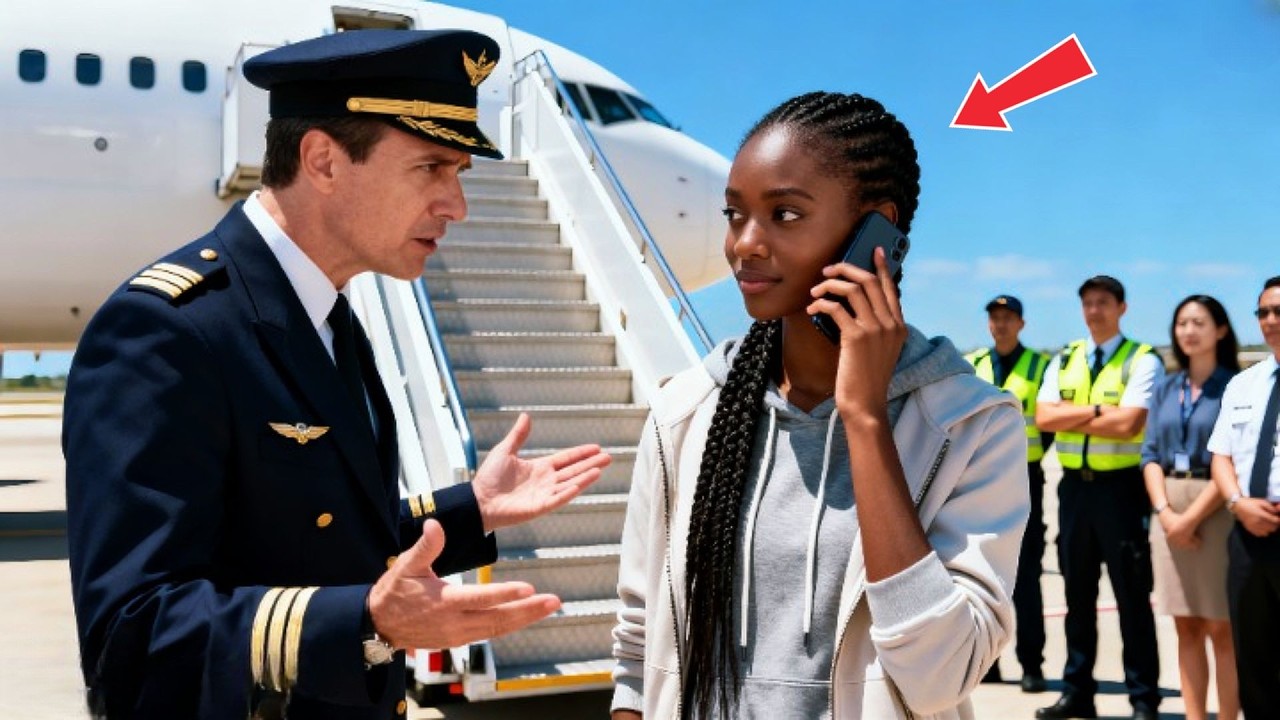
“Just because she has a degree doesn’t mean she knows how to fly.”
“She knows the rotation speed, though,” David noted dryly.
“Shut up, David.”
Richard stared out the window.
The Atlantic Ocean stretched beneath them like a vast blue sheet.
He was angry now.
The embarrassment had curdled into resentment.
Who was she to tell him how to fly?
He was Captain Sterling.
He had handled emergencies she couldn’t even dream of.
He wished darkly that something would happen—just a minor thing, something requiring true pilot airmanship.
Then she would see.
Then she would realize that books and degrees meant nothing when turbulence hit.
He should have been careful what he wished for.
Three hours later, halfway between New York and London, a warning chime pinged on the overhead panel.
An amber light illuminated.
L HYD PRESS LOW.
Richard sat up straighter.
“Left hydraulic pressure low.”
“Confirm,” David said, his voice sharpening.
“Pressure is dropping fast.”
“We have a leak.”
A voice echoed in the back of Richard’s mind.
She told you.
Shut the valve.
“Isolate the system,” Richard ordered.
David flipped the switches.
“Valve closed.”
“Pressure is still dropping.”
“It’s the primary reservoir.”
“We’re losing the blue system.”
Richard felt a cold spike of adrenaline.
The blue hydraulic system powered critical flight controls, landing gear functions, and nose-wheel steering.
Losing it was bad.
Losing it over the middle of the Atlantic was worse.
“We need to divert,” David said.
“Shannon is the closest.”
“No,” Richard replied.
His pride overrode his logic.
“We can make London.”
“We have backup systems.”
“I’m not diverting for a minor leak.”
“Imagine the delay.”
“She’ll fire me for sure if I strand her in Ireland.”
“Richard, the checklist says—”
“I know what the checklist says.”
“We press on.”
The cockpit door opened.
Alicia stood there.
She wasn’t wearing her headphones anymore.
“Why did the pitch trim just disengage?” she asked calmly.
Richard turned around, sweat beading on his forehead.
“We have a minor indication.”
“It’s under control.”
Alicia looked at the center console.
Her eyes darted to the hydraulic pressure gauge.
It was at zero.
“You lost the blue system,” she stated.
“And you haven’t started a descent.”
“Why aren’t we diverting?”
“We are continuing to London,” Richard said through gritted teeth.
“I have redundancy.”
“You have a leak that could affect the other systems if it’s a transfer-unit failure,” Alicia replied.
“And you’ve lost nose-wheel steering.”
“Landing at Heathrow with crosswinds and no steering is a risk we do not take.”
“Divert to Shannon.”
“I am the captain!” Richard roared.
“I make the decisions.”
Alicia leaned into the cockpit.
“And I am the owner telling you that you are endangering this aircraft to save your own ego.”
“Divert to Shannon, Captain, or I will have David fly this plane.”
Richard looked at David.
David looked at Alicia, then back at Richard.
“She’s right, Captain,” David said softly.
“We need to set down.”
Richard gripped the yoke, his knuckles white.
He was cornered by the manual, by his co-pilot, and by the woman he had insulted.
“Fine,” Richard spat.
He set course for Shannon.
The descent toward Shannon Airport was anything but routine.
The weather in Ireland was living up to its reputation.
Gray.
Blustery.
Unforgiving.
Rain lashed against the windshield of the Gulfstream, streaking horizontally as the jet fought through turbulence.
Inside the cockpit, the atmosphere was toxic.
The low-hydraulic-pressure warning was now accompanied by a flap-fail message.
The loss of the blue hydraulic system meant they couldn’t deploy the flaps or slats hydraulically.
They would have to come in fast.
Much faster than a standard landing.
Alicia said, turning to walk toward the FBO terminal.
“Or you could have just treated me like a human being.”
She stopped and looked back one last time.
“Enjoy the commercial flight home, Richard. I hear the middle seats are particularly educational.”
The journey back to New York was a masterclass in irony.
Captain Richard Sterling, a man who had spent the last fifteen years sipping espresso in the cockpits of sixty-million-dollar jets, found himself in Terminal 3 at Heathrow clutching a boarding pass for a commercial flight.
Zone 5.
Seat 42E.
The middle seat.
He hadn’t been able to change out of his uniform. His luggage was still on the Gulfstream in Shannon, impounded for the investigation.
So he walked through the terminal in his pilot’s trousers and white shirt, though he had shamefully removed the epaulettes and stuffed them into his pocket.
He looked like a demoted general retreating from a lost war.
As he boarded the crowded Boeing, the air was thick with the smell of stale coffee and humanity.
A flight attendant, a woman near his own age who looked exhausted, glanced at his uniform shirt.
“Deadheading back?” she asked, assuming he was a pilot hitching a ride for work.
“Something like that,” Richard mumbled.
He found Row 42.
To his left was a teenager with an oversized backpack that invaded his legroom.
To his right was a mother with an infant who was already screaming before the doors had even closed.
Richard squeezed into the middle seat, his knees pressed against the tray table in front of him.
He closed his eyes, trying to dissociate from reality.
Just twenty-four hours ago, he had been standing on the tarmac at Teterboro, king of his domain, sneering at a woman in a NASA T-shirt.
“I don’t fly backpackers,” he had said.
Now he was literally rubbing shoulders with them.
The flight was eight hours of torture.
The baby screamed for five of them.
The teenager fell asleep and drooled on Richard’s shoulder.
When the meal service came—a sad foil-wrapped tray of pasta—Richard stared at it, remembering the caviar and champagne chilling in the galley of the Gulfstream.
He had plenty of time to think.
At first, his mind was filled with righteous indignation.
“She’s overreacting,” he told himself.
“It was a judgment call. I’m a veteran. The union will back me up.”
But as the hours dragged on and turbulence rattled the plastic cabin walls, a colder, harder truth began to settle in.
He replayed the landing in Shannon.
The speed.
The bounce.
The urge to grab the tiller.
He knew, deep down in the place where pilots keep their true fears, that she was right.
He had been scared.
He had been behind the airplane.
And he had ignored a critical warning because he couldn’t bear to admit the woman in the hoodie knew more than he did.
By the time the plane touched down at JFK, Richard wasn’t angry anymore.
He was hollow.
He took a cab to Apex Aviation headquarters in Manhattan.
It was a Sunday evening, but he had been summoned.
The email he received upon landing was brief:
Mandatory Debriefing.
Four o’clock p.m.
Boardroom B.
He walked into the glass-and-steel lobby of the Apex building.
The security guard, a man Richard had walked past a hundred times without acknowledging, looked up.
“ID, please.”
“It’s me, Frank. Captain Sterling.”
“I know who you are, sir,” the guard replied.
“I still need to scan your ID. Protocol.”
Richard handed over his badge.
The scanner beeped red.
Access denied.
The guard looked up.
There was a flicker of something in his eyes.
Pity.
“I have to issue you a visitor pass, sir. You’ve been scrubbed from the system.”
Richard felt his stomach drop.
It was happening fast.
He took the sticky paper badge marked VISITOR and attached it to his wrinkled white shirt.
He rode the elevator to the fortieth floor.
The hallway was silent.
The lights were dimmed except for the conference room at the end.
The elevator ride felt less like an ascent and more like a pressurized dive.
Richard watched the floor numbers tick upward.
Thirty-eight.
Thirty-nine.
Forty.
With each chime, his heart hammered harder against his ribs.
He adjusted his tie for the tenth time.
It was a cheap clip-on purchased from an airport gift shop because he couldn’t bear to wear the uniform without the epaulettes.
Looking at his reflection in the polished brass doors, he realized he looked exactly like what he was.
A man in a costume.
The doors slid open.
The executive floor of Apex Aviation was usually a place of hushed reverence, carpeted in deep navy wool and scented with fresh lilies.
Tonight the silence felt predatory.
A receptionist Richard had known for five years sat behind the glass desk.
She didn’t look up.
“I’m here for the meeting,” Richard said.
“Boardroom B.”
“They are waiting for you, Mr. Sterling,” she replied, eyes fixed on her screen.
She didn’t call him Captain.
The omission hit him like a slap.
Richard walked down the long corridor.
The walls were lined with framed photographs of the company’s fleet.
G650s.
Global 7500s.
Challengers.
He appeared in three of those photographs.
He wondered how long it would take for them to disappear.
He reached the heavy double doors of Boardroom B.
He took a breath.
Summoned the ghost of his old arrogance.
Then pushed the doors open.
The temperature inside felt instantly colder.
The room was vast, dominated by a twenty-foot mahogany table gleaming beneath harsh recessed lights.
At the far end, silhouetted against floor-to-ceiling windows overlooking Manhattan, sat the tribunal.
Alicia Thorne occupied the center seat.
The transformation was complete.
The vintage NASA shirt and cargo pants were gone.
In their place was a tailored slate-gray suit that radiated executive authority.
Her braids were pulled into a severe bun, emphasizing the sharp lines of her face.
She no longer looked like a mechanic or engineer.
She looked like a judge.
To her right sat Marcus.
To her left sat a corporate attorney with a laptop and a stack of thick files.
In the corner sat David.
“Take a seat, Mr. Sterling,” Alicia said.
Her voice was quiet.
Emotionless.
Richard sat at the opposite end of the table.
The distance between them felt like a mile.
“Dr. Thorne. Marcus. Look, I know emotions are high after the diversion. I’m prepared to debrief the incident. I have notes regarding the windshear and sensor malfunctions.”
“There were no sensor malfunctions,” Alicia interrupted.
“We pulled the raw flight-data recorder information an hour ago.”
“The sensors were functioning perfectly.”
“The hydraulic pressure was zero because the fluid was gone.”
“The fluid was gone because the seal failed.”
“The seal failed because, as I told you in Teterboro, it was degraded.”
“It was a judgment call,” Richard insisted.
“This isn’t a debriefing, Richard,” Marcus said wearily.
“This is a termination hearing.”
Richard froze.
Termination.
The word echoed through the room.
“We aren’t firing you for the diversion,” the attorney said.
“We are firing you for gross negligence, insubordination, and violations of the Safety Management System.”
She slid a document across the polished table.
It stopped in front of him.
A transcript.
“We listened to the cockpit voice recorder,” Alicia said.
“Do you know what the most frightening part was?”
“It wasn’t the wind.”
“It wasn’t the alarms.”
“It was the silence.”
“The silence when your first officer warned you.”
“The silence when I warned you.”
“You were so busy filtering out voices you didn’t respect—David because he was young and me because I was a woman—that you went deaf to reality.”
“I am the captain!” Richard shouted, slamming his hand onto the table.
“By aviation law I am the final authority on that aircraft. I do not take orders from passengers.”
“And that,” Alicia replied calmly, “is why you will never fly again.”
She turned toward David.
“Captain David, please read the transcript from the landing roll.”
Richard stared.
“Captain David? He’s a kid.”
“He’s a first officer.”
David stood.
His voice was steady.
“At timestamp 14:05, Captain Sterling attempted to reach for the nose-wheel tiller. I shouted, ‘Reverse thrusters.’ Dr. Thorne shouted, ‘Don’t touch the tiller.’”
“If he had turned it, the nose gear could have collapsed.”
“I didn’t turn it!” Richard protested.
“You didn’t because we stopped you,” Alicia said.
“In this business, hesitation born of ego can kill people.”
She opened another file.
“Let’s discuss the cost of that ego.”
“The landing gear strut is twisted.”
“The tires are destroyed.”
“The brakes are fused.”
“The structural inspection alone will cost two hundred thousand dollars.”
“The aircraft will be out of service for three weeks.”
“Estimated lost charter revenue: one-point-two million dollars.”
Richard swallowed.
The numbers were crushing.
“We can absorb the money,” Alicia continued.
“What we cannot absorb is the liability of employing someone who believes seniority outweighs physics.”
The attorney cleared her throat.
“Under Article Four, Section Two of your employment contract, willful misconduct voids your severance package.”
“It voids your stock options.”
“It voids your accumulated flight benefits.”
Richard felt the blood drain from his face.
“My stock options?”
“I have half a million dollars in unvested Apex stock.”
“That’s my retirement.”
“It was your retirement,” the attorney corrected.
“It has been clawed back.”
Richard looked desperately at Marcus.
“I have a mortgage.”
“I have alimony.”
Marcus lowered his eyes.
“You signed the contract, Richard.”
“And after what you said on the recorder about Alicia, I can’t protect you.”
“I don’t want to.”
Richard turned back toward Alicia.
For the first time, he saw the situation clearly.
The woman he had dismissed as a backpacker hadn’t simply been a passenger.
She had been a test.
And he had failed.
“Alicia,” he said quietly.
“Please.”
“Ground me for a month.”
“Send me to retraining.”
“Don’t end it like this.”
“Flying is all I have.”
Alicia stood.
She walked slowly around the table.
The clicking of her heels echoed through the room.
She stopped beside him.
“You don’t love flying, Richard,” she said softly.
“You love being important.”
“You love the uniform.”
“You love the way people look at you when you walk through a terminal.”
She placed a white envelope in front of him.
“This is your FAA report.”
“I have filed a formal complaint regarding your judgment and crew resource management failures.”
“It will follow you to every airline, charter operator, and cargo carrier that reviews your record.”
“You’re blacklisting me,” Richard whispered.
“No,” Alicia replied.
“I’m grounding you.”
“I’m making sure no one else has to sit inside a metal tube forty thousand feet in the air with someone who thinks he knows better than the machine and the people who built it.”
She straightened and nodded toward the security guards.
“Escort Mr. Sterling out.”
“Take his badge.”
“Ensure he does not access the crew lounge.”
Richard rose slowly.
He looked at David.
“You stabbed me in the back.”
David met his gaze.
“No, Richard.”
“I stopped you from crashing us.”
“There’s a difference.”
Richard turned toward Alicia one final time.
He wanted a cutting remark.
Some final act of defiance.
But there was nothing left.
“Goodbye, Richard,” Alicia said.
“Check the gate next time.”
Richard walked out.
The hallway seemed endless.
The photographs of the jets appeared to mock him.
At the elevator, a guard removed the badge from his belt loop.
The doors closed.
His reflection stared back from the polished metal.
He looked old.
He looked tired.
And for the first time in thirty years—
he looked like a passenger.
News

Black Female CEO Told to Give Up VIP Seat for White Traveler — One Phone Call Locks $940M…
Black Female CEO Told to Give Up VIP Seat for White Traveler — One Phone Call Locks $940M. They looked…
Kelly Ripa and Mark Consuelos Break Down in Tears on Live TV: The Heartwarming Bombshell About Son Joaquin That Has Fans Reaching for Tissues
Kelly Ripa and Mark Consuelos couldn’t hold it together—and neither will you. The tearful bombshell about their youngest son just…

Savannah Guthrie anchors America’s biggest show—but behind the bright studio lights, Savannah Guthrie was silently drowning. What she finally admitted about the one night that broke her—and the promise that pulled her back—will leave you breathless.
Savannah Guthrie anchors America’s biggest show—but behind the bright studio lights, Savannah Guthrie was silently drowning. What she finally admitted…

Savannah Guthrie just blew the lid off something HUGE on live television—and the reaction from the Today show crew says it all.
Savannah Guthrie just blew the lid off something HUGE on live television—and the reaction from the Today show crew says…
White Passenger Takes Black Woman CEO’s Seat smirked as he took her seat. She smiled and made one call. When the captain announced we were turning back, I thought it was weather—until I saw who was waiting on the tarmac.
White Passenger Takes Black Woman CEO’s Seat smirked as he took her seat. She smiled and made one call. When…
Customs Officer Rips a Black Woman’s Visa — Seconds Later, a Call Comes from the White House…
Customs Officer Rips a Black Woman’s Visa — Seconds Later, a Call Comes from the White House… The sound wasn’t…
End of content
No more pages to load