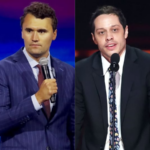
Pete Davidson just nuked the Netflix roast of Kevin Hart — making a vile, graphic joke about Turning Point USA’s Charlie Kirk that left Shane Gillis speechless.
Netflix’s controversial live comedy special “The Roast of Kevin Hart” has ignited a fierce wave of criticism online after comedian Pete Davidson delivered a series of vulgar jokes referencing slain Charlie Kirk during the high-profile event hosted by Shane Gillis.
What was intended to be another headline-grabbing night of edgy celebrity humor quickly spiraled into a heated cultural flashpoint, with viewers, political commentators, and entertainment critics sharply divided over whether the performance crossed the line from dark comedy into outright disrespect.
The live roast, released by Netflix as part of its growing slate of uncensored stand-up and celebrity comedy specials, featured a lineup of comedians and entertainers taking turns mocking Kevin Hart in front of a packed audience.
But while celebrity roasts have long thrived on shock value, many viewers said Davidson’s remarks involving Kirk’s death pushed the format into dangerous territory.
Almost immediately after the special aired, clips of Davidson’s comments began circulating across social media platforms including X, TikTok, Reddit, and YouTube.
Within hours, hashtags connected to the controversy surged into trending territory, fueling debates about comedy, political sensitivity, free speech, and the growing tension between entertainment culture and ideological division in America.
Critics accused Davidson of exploiting a deeply polarizing political tragedy for laughs, arguing that the material was unnecessarily graphic and inappropriate for a mainstream streaming event watched by millions around the world.
Conservative commentators, particularly those aligned with Turning Point USA supporters, condemned the performance as “disgusting,” “dehumanizing,” and “proof of Hollywood’s double standards.”
Supporters of Davidson, however, defended the comedian by arguing that roast culture has historically embraced offensive humor aimed at public figures from every political and cultural background.

Many fans pointed out that celebrity roasts are intentionally provocative and that audiences tuning into such events generally expect boundary-pushing material.
The backlash intensified because of the broader political climate surrounding Kirk’s legacy. As the founder of Turning Point USA, Kirk remained one of the most recognizable conservative activists in modern American politics.
Known for his outspoken campus appearances, social media influence, and ties to Republican political circles, Kirk was both celebrated and criticized throughout his public career.
Following news of Davidson’s jokes, several conservative influencers and political commentators demanded that Netflix issue an apology or remove the segment entirely from the archived version of the special.
Some even called for boycotts against the streaming platform, accusing the company of profiting from inflammatory political humor while claiming to support inclusivity and social responsibility in other contexts.
Entertainment analysts noted that the controversy reflects a growing challenge for streaming companies attempting to balance uncensored creative freedom with increasingly fragmented audience expectations.
Over the past several years, Netflix has repeatedly faced public criticism over stand-up specials involving politically charged jokes, offensive language, and controversial topics. Executives at the company have often defended comedians’ rights to artistic expression, even amid intense backlash campaigns.
For Davidson, the incident adds another chapter to a career frequently defined by controversy, personal candor, and unpredictable public appearances.
Rising to national fame through Saturday Night Live, Davidson cultivated a reputation for self-deprecating humor and emotionally raw comedy rooted in personal trauma, celebrity culture, and current events. His willingness to tackle uncomfortable subjects has earned him both loyal fans and vocal critics.
Observers noted that Davidson’s appearance at the roast carried particular attention because of his recent return to high-profile comedy projects following periods away from the public spotlight.
Industry insiders suggested Netflix likely expected provocative headlines from the special, though few anticipated the scale of the reaction now unfolding online.
Meanwhile, Shane Gillis, who served as host of the event, also became entangled in the debate. Gillis himself has faced prior controversy over offensive jokes and comments made earlier in his career.
Some critics argued that Netflix intentionally leaned into comedians known for controversial humor in an effort to generate viral attention and dominate online conversation.
Public relations experts say the controversy demonstrates how live-streamed comedy now operates in a radically different media environment compared to traditional roast events from previous decades.
In earlier eras, controversial jokes might generate temporary headlines before fading away.
Today, however, short video clips can spread globally within minutes, allowing isolated moments to become cultural battlegrounds almost instantly.
Social media users from across the political spectrum weighed in heavily. Some defended Davidson by invoking free speech and the historical role of satire in entertainment.
Others argued that comedians should exercise greater restraint when discussing individuals connected to violent or traumatic events.
One viral post criticizing the performance described the jokes as “a new low even for roast comedy,” while another user countered that audiences “cannot selectively support edgy comedy only when it targets people they dislike.”
The divide underscored how modern comedy increasingly functions as a proxy war for larger ideological and cultural conflicts.
Media scholars observing the fallout noted that roast comedy has always depended on escalating shock value to maintain relevance.
From the days of old-school celebrity roasts on cable television to the modern streaming era, performers have consistently pushed boundaries in pursuit of viral moments and audience attention.
Yet the digital age has dramatically amplified the consequences of those attempts.
The controversy also reignited longstanding debates about whether comedians should be treated differently from political commentators or public figures when discussing sensitive topics. Defenders of Davidson insisted that comedy should remain unrestricted, even when offensive.
Critics responded that massive streaming platforms with global reach carry responsibilities that smaller comedy clubs do not.
Within entertainment circles, analysts suggested the backlash may ultimately benefit Netflix in terms of publicity.
Controversial comedy specials often generate enormous spikes in online engagement, viewership, and media coverage, even when criticism dominates headlines. In the streaming wars, visibility itself has become a form of currency.
Still, others warned that repeated controversies could gradually damage Netflix’s public image among mainstream audiences who feel exhausted by increasingly divisive entertainment content.
Some subscribers expressed frustration that celebrity comedy events now appear designed primarily to provoke outrage rather than deliver humor.

As clips from the roast continued circulating, several prominent conservative personalities publicly attacked Davidson and Netflix while demanding accountability.
At the same time, comedians and free-speech advocates warned against attempts to censor performers based on audience outrage.
The incident has also highlighted the evolving relationship between politics and mainstream entertainment.
In previous decades, celebrity roasts largely targeted actors, musicians, athletes, and fellow comedians.
Today, political figures and activists increasingly occupy the same pop-cultural ecosystem as Hollywood celebrities, making them frequent subjects of comedy routines, satire, and internet discourse.
Experts say this convergence creates especially volatile reactions because audiences no longer consume entertainment and politics separately.
Instead, cultural identity, political affiliation, and media preferences have become deeply intertwined. As a result, jokes aimed at political figures can trigger emotional responses far beyond traditional entertainment criticism.
Some media commentators argued that Davidson’s jokes were part of a broader trend in modern comedy where shock value increasingly outweighs wit or originality.
Others countered that outrage itself has become performative, with social media users and commentators amplifying controversies for engagement and visibility.
Netflix has not immediately announced whether edits will be made to the archived version of the roast. Historically, the company has resisted removing controversial stand-up material despite organized backlash campaigns.
Company executives have repeatedly emphasized their commitment to artistic freedom and broad creative expression across genres.
For Kevin Hart, the controversy surrounding the roast threatens to overshadow what was intended as a major comedy event celebrating his career.
Hart, one of the most commercially successful comedians of his generation, has built a global entertainment empire spanning stand-up, film, television, and business ventures.
Yet much of the media attention following the special shifted away from Hart himself and toward Davidson’s inflammatory remarks.
Entertainment reporters noted the irony that roasts traditionally aim to honor their central subject through exaggerated insults and comedic attacks.
Instead, this particular event became dominated by a broader national argument over acceptable humor and political sensitivity.
Industry observers believe the fallout could influence how streaming platforms approach future live comedy events.
Some producers may become more cautious about politically charged material, while others may view controversy as evidence that boundary-pushing comedy still commands enormous public attention.
The debate surrounding Davidson’s performance ultimately reflects larger unresolved tensions in American culture: the limits of satire, the role of comedy in political discourse, and the growing collision between entertainment, ideology, and internet outrage.
Whether audiences see the jokes as offensive cruelty or protected artistic expression largely depends on broader beliefs about free speech, comedy, and political identity itself.
As the backlash continues to unfold, one thing has become unmistakably clear: in the age of viral media and hyper-polarized audiences, even a celebrity roast can rapidly evolve into a nationwide cultural controversy.
News
Kansas City Chiefs WR Rashee Rice Faces Probation Violation After Positive Marijuana Test
Kansas City Chiefs WR Rashee Rice Faces Probation Violation After Positive Marijuana Test Kansas City, MO — May 20, 2026…
Gaten Matarazzo Embarks on Exciting West End Journey with Debut in Musical RENT
Gaten Matarazzo Embarks on Exciting West End Journey with Debut in Musical RENT In a remarkable turn of events that has…
Stephen Colbert Drops a Jaw-Dropping Bombshell: The Final Guests on The Late Show Revealed—Fans Stunned by Unexpected Names, Hidden Surprises, and Secrets Behind His Last Episode That No One Could Have Predicted
LEAKED: Stephen Colbert’s final guests are NOT who you think. One name is so unexpected, it’ll break your brain. Another…
Black CEO Humiliated by Luxury Car Showroom Director — She Pulled a $6 Billion Deal and the Company Never Recovered
Black CEO Humiliated by Luxury Car Showroom Director — She Pulled a $6 Billion Deal and the Company Never Recovered…
Bank Manager Calls Black Teen’s Mom “Nobody” — Then She Fires the Branch Manager With One Call
Bank Manager Calls Black Teen’s Mom “Nobody” — Then She Fires the Branch Manager With One Call In a moment…
Millionaire’s Bodyguard Threw a Veteran From His Wheelchair — Until a Marine and His K9 Stepped In
Millionaire’s Bodyguard Threw a Veteran From His Wheelchair — Until a Marine and His K9 Stepped In The late afternoon…
End of content
No more pages to load