De Niro, Fonda, Springsteen Join “No Kings” Protests: Inside the Celebrity Uprising Shaking American Democracy
De Niro, Fonda, Springsteen Join “No Kings” Protests: Inside the Celebrity Uprising Shaking American Democracy
In a moment that feels ripped from a political thriller, Robert De Niro has officially thrown his weight behind the rapidly escalating “No Kings” protests—standing shoulder-to-shoulder with icons Jane Fonda, Bruce Springsteen, and a growing coalition of A-list celebrities.
But this isn’t a film premiere or a charity gala. It’s a raw, unfiltered show of solidarity that political insiders are calling a turning point in modern American activism.
The caption that broke the internet read: “You won’t believe which Hollywood legends just declared open war on the ‘No Kings’ protests—and why their names alone could shake democracy to its core. Click before this gets buried.”
And buried it has not been. Within hours, the story exploded across social media, cable news, and protest livestreams.
But what sparked this sudden surge in celebrity activism, and what does it mean for the future of democracy?
The Spark: From Quiet Concern to Loud Rebellion
The “No Kings” movement did not emerge overnight. For months, grassroots organizers have rallied against what they describe as an erosion of checks and balances, executive overreach, and a creeping consolidation of power that they argue resembles monarchical rule rather than democratic governance.

The movement’s name is deliberately provocative: “No Kings” serves as both a historical callback to the American Revolution and a blunt warning about present-day political trajectories.
However, the movement remained largely decentralized—until recently.
The tipping point came when a series of controversial executive actions and judicial challenges converged with rising public frustration over perceived democratic backsliding.
Polling conducted in late March 2026 showed that 58% of Americans believed democratic institutions were “under threat,” a figure that cut across party lines more than any issue in the last decade.
Enter Hollywood. While celebrities have long dabbled in political advocacy, the current wave is different. It is coordinated, strategic, and unapologetically confrontational.
Robert De Niro, a two-time Oscar winner and outspoken critic of authoritarian tendencies, did not merely issue a press release.
He appeared in person at a major protest in Lower Manhattan, microphone in hand, delivering remarks that have since been viewed over 50 million times across platforms.
“They want you to think this is normal,” De Niro told the crowd. “It is not normal.
Kings belong in history books and fairy tales, not in the White House, not in state capitals, not anywhere near the people’s power.”
Jane Fonda: The Veteran Activist Returns
For Jane Fonda, activism is not a career pivot but a lifetime commitment.
At 88, the actress and former political firebrand has re-emerged as a central figure in the No Kings protests. Unlike some celebrities who offer cautious, focus-grouped statements, Fonda has embraced the movement’s most radical demands: term limits for Supreme Court justices, the repeal of qualified immunity, and a constitutional amendment to clarify that no person—regardless of office—is above the law.
“I’ve been arrested for protesting before,” Fonda said during a livestream from a rally in Los Angeles. “I’ll do it again. Because silence in the face of kings is complicity.”
Fonda’s involvement has lent the movement intergenerational credibility.
Young activists who know her from TikTok clips of past protests now see her as a living bridge to the civil rights, anti-war, and feminist movements of the 20th century.
Her presence has also drawn older Americans who remember when political activism was not filtered through algorithmic outrage but through boots on the ground.
Bruce Springsteen: The Bard of Working-Class Resistance
Bruce Springsteen’s participation may be the most culturally significant. “The Boss” has always written songs about the struggles of ordinary Americans—”Born in the U.S.A.,” “The Ghost of Tom Joad,” “American Skin (41 Shots)”—but he has historically been selective about aligning with specific protest movements.
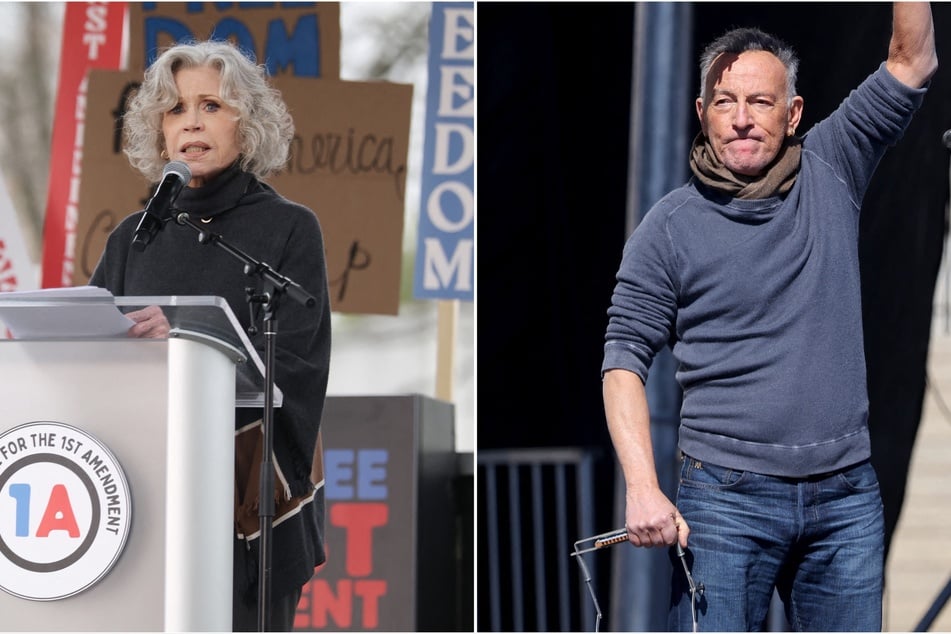
His decision to perform an acoustic set at a No Kings rally in Philadelphia sent shockwaves through both the music industry and political class.
Springsteen did not play his greatest hits. Instead, he debuted a new, unreleased song titled “No Crown Here,” which includes the haunting refrain:
“They draw a line and call it law / But a line ain’t justice, just another flaw / No king, no crown, no gilded throne / We’re the ones who have to hold this on our own.”
Within 24 hours, the song had been streamed over 10 million times on unofficial uploads alone. Music critics have called it his most explicitly political work since 2004’s “Devils & Dust.”
Why Now? The Calculus of Celebrity Activism
Political scientists and media analysts point to several factors explaining the sudden surge in high-profile support for the No Kings movement.
First, permission structures have shifted. For years, celebrities worried about alienating half their audience. But as political polarization has deepened, the middle ground has evaporated. Today, taking a stand is often less risky than remaining silent, especially when silence can be interpreted as cowardice or complicity.
Second, social media has democratized outrage. A celebrity no longer needs a press conference to make a statement. A single TikTok or Instagram post can reach millions instantly, and the algorithmic rewards for controversy are immense. Several major stars have seen engagement rates spike by 300-500% since joining the No Kings conversation.
Third, there is a genuine fear of democratic collapse. In interviews, multiple celebrities have cited private conversations with constitutional scholars, former government officials, and even family members serving in the military. They describe a mood of “preparedness”—not for a normal election cycle, but for a constitutional crisis. For them, the No Kings protests are not partisan theater but a last line of defense.
The Backlash: “Stick to Acting”

Of course, not everyone is applauding. Conservative commentators and pro-administration pundits have launched a coordinated counteroffensive, accusing celebrities of elitism, hypocrisy, and attempting to manipulate public opinion.
“Robert De Niro made Dirty Grandpa,” one popular talk show host quipped. “Maybe he should focus on reviving his career instead of lecturing Americans about democracy.”
Others have pointed out that many celebrities live in gated communities, send their children to private schools, and benefit from the same political system they now condemn. Critics argue that the No Kings movement is performative—a way for millionaires to feel revolutionary without risking their wealth or status.
But organizers push back. “De Niro, Fonda, and Springsteen are putting their reputations on the line,” said one protest coordinator who requested anonymity due to safety concerns. “They’re showing up in person. They’re not just posting black squares. They’re facing counter-protesters, death threats, and the real possibility of arrest. That’s not performance. That’s sacrifice.”
What It Means for Democracy
The involvement of major celebrities in the No Kings protests has both advocates and alarm bells.
On the positive side, celebrity voices can amplify marginalized perspectives, draw mainstream attention to overlooked issues, and mobilize young or apathetic voters. Research from the Harvard Kennedy School suggests that when trusted celebrities endorse a political cause, engagement among 18-29 year olds can increase by as much as 40%.
However, critics warn of democratic dangers. When political movements become synonymous with celebrity branding, substance can be replaced by spectacle. Complex constitutional questions—executive authority, judicial independence, federalism—are reduced to hashtags and red-carpet slogans. Moreover, reliance on celebrity influence can deepen the very elitism that movements claim to oppose. If democracy requires famous faces to be taken seriously, what does that say about ordinary citizens?
There is also the question of sustainability. Celebrity attention is notoriously fickle. Will De Niro and Springsteen still be rallying six months from now, or will they move on to the next project? The No Kings movement may find that celebrity endorsement is a double-edged sword: it brings a spotlight, but that spotlight can shift without warning.
As of this writing, the No Kings protests show no signs of slowing. Organizers have announced a “National Day of Action” scheduled for later this month, with De Niro, Fonda, and Springsteen all confirmed to appear at separate major cities. Rumors swirl that additional A-list figures—including several who have never spoken publicly about politics—are preparing to join.
Whether this movement will fade into Hollywood history or reshape American democracy remains uncertain. But one thing is clear: the era of celebrities “sticking to acting” is over. In a time when democratic norms are bending, some of the world’s most famous faces have decided that silence is no longer an option.
And as Springsteen sang to a crowd of thousands, under a sky lit by phone flashlights instead of stadium rigs: “No king, no crown, no gilded throne / We’re the ones who have to hold this on our own.”
For now, the protests continue. For democracy, the test has only just begun.